| Organic Seeds | Edible Plants | Organic Pest Controls | Books | Tools, Propagation & Fertilisers | Sprouting & Microgreens | Poultry Supplies | Specials & Gift Ideas |

Top

We will send an email to this address*
when is next available
* we will use this email address only for this notification and then we will delete it.
 Home
Home
Green Harvest Organic Gardening Supplies is permanently closed as of 5pm on 1-11-2023.
We will not be taking orders by this website, in person, by phone or email. Our display garden and retail shop are closed forever.
Read more...
Phone:07 54357000
Phone calls will only be responded to sporadically and only in reference to orders placed prior to 2-11-2023. All the useful growing and organic pest management research and resources are available on this website for a while still.
 AVAILABLE FOR PURCHASE:
buy or get emailed when available
AVAILABLE FOR PURCHASE:
buy or get emailed when availableARROWHEAD GROWING INFORMATION © Frances Michaels
BOTANICAL NAME: Sagittaria sagittifolia syn. Sagittaria sinensis
FAMILY: Alismataceae
PLANT DESCRIPTION
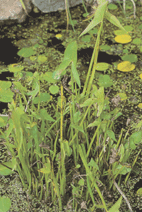
An attractive aquatic edge plant with arrow shaped leaves and edible tubers. This species doesn't appear to flower and so will not spread from seed. This is desirable as some species of Sagittaria do set seed and can become weedy. It is very hardy, grows to 30 cm high and likes full sun.
USES
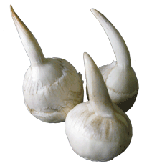
The tuber flesh is cream coloured and is eaten boiled, baked or fried, it should not be eaten raw. The protein content of 4 to 7% is high for a root crop. The young shoots can also be eaten. A simple way to prepare arrowhead is to boil tubers until tender, slice it thin and serve with butter or sesame oil. If any should be left over, unbuttered, serve cold with a vinaigrette dressing as a salad.
 PLANTING DETAILS
Plant the tubers in early spring 4 - 5 cm deep and space the tubers at least 10 cm apart. This is an easy to grow plant with no special growing requirements other than maintaining a cover of shallow water, 10 cm deep, over the soil. A pond isn't necessary to grow most aquatic edible plants, old concrete laundry tubs and bathtubs can be recycled. If they are sunk into the ground and edged with rocks, they can look very attractive. If using this type of container to grow aquatic edible plants, than the entire container should be two-thirds filled with a mixture of 70% good quality topsoil, preferably a loam containing some clay and 30% well-rotted manure or compost. Make sure when adding the soil that enough head room is left to add the correct depth of water. The tubers can be planted directly into this soil mix and water added until the surface is covered to the appropriate depth. If using a pond than suitable large pots would be filled with the soil mix and the tubers planted into this, finish by using a topping of gravel or pebbles as a mulch to keep the soil in place. Water well before placing in the pond. If necessary arrange bricks under the pots to bring them to the correct depth from the surface of the water. To construct a pond a waterproof lining will be needed. This can be made of concrete or a synthetic rubber liner. Synthetic rubber or EPDM. liners are long lasting and flexible and easy to install. Concrete is the most versatile material.
HARVEST
The tubers are ready to harvest when the leaves turn yellow and die back.
More info on edible waterplants...
Not to NORFOLK ISLAND, NT, SA, TAS or WA
SORRY but due to quarantine restrictions between Australian States no plants at all can be ordered by residents of Norfolk Island, Tasmania and Western Australia. These restrictions are very important as they prevent the spread of plant pests and diseases. No potatoes, garlic, shallots, strawberries or tubestock can be sent to South Australia. No tubestock can be sent to Northern Territory.
Home
Green Harvest Organic Gardening Supplies is permanently closed as of 5pm on 1-11-2023.
We will not be taking orders by this website, in person, by phone or email. Our display garden and retail shop are closed forever.
Read more...
Phone:07 54357000
Phone calls will only be responded to sporadically and only in reference to orders placed prior to 2-11-2023. All the useful growing and organic pest management research and resources are available on this website for a while still.
DISCLAIMER:
No liability will be accepted by Green Harvest, its owners or employees as to the accuracy of any information. No responsibility will be taken for damage to property or persons due to information given about a product or technique. No responsibility will be taken for the loss of a crop or income due to information given about a product or technique.
 Shopping here is private and secure.
Copyright © 2001 - 2024 Green Harvest Organic Gardening Supplies
No part of this website may be reproduced without permission of the owner
SORRY but due to quarantine restrictions between Australian States no plants at all can be ordered by residents of Norfolk Island, Tasmania and Western Australia. These restrictions are very important as they prevent the spread of plant pests and diseases. No potatoes, garlic, shallots, strawberries or tubestock can be sent to South Australia. No tubestock can be sent to Northern Territory.
Home
Green Harvest Organic Gardening Supplies is permanently closed as of 5pm on 1-11-2023.
We will not be taking orders by this website, in person, by phone or email. Our display garden and retail shop are closed forever.
Read more...
Phone:07 54357000
Phone calls will only be responded to sporadically and only in reference to orders placed prior to 2-11-2023. All the useful growing and organic pest management research and resources are available on this website for a while still.
No liability will be accepted by Green Harvest, its owners or employees as to the accuracy of any information. No responsibility will be taken for damage to property or persons due to information given about a product or technique. No responsibility will be taken for the loss of a crop or income due to information given about a product or technique.
Shopping here is private and secure.
Copyright © 2001 - 2024 Green Harvest Organic Gardening Supplies
No part of this website may be reproduced without permission of the owner