| Organic Seeds | Edible Plants | Organic Pest Controls | Books | Tools, Propagation & Fertilisers | Sprouting & Microgreens | Poultry Supplies | Specials & Gift Ideas |

Top

We will send an email to this address*
when is next available
* we will use this email address only for this notification and then we will delete it.
 Home
Home
Green Harvest Organic Gardening Supplies is permanently closed as of 5pm on 1-11-2023.
We will not be taking orders by this website, in person, by phone or email. Our display garden and retail shop are closed forever.
Read more...
Phone:07 54357000
Phone calls will only be responded to sporadically and only in reference to orders placed prior to 2-11-2023. All the useful growing and organic pest management research and resources are available on this website for a while still.
 AVAILABLE FOR PURCHASE:
buy or get emailed when available
AVAILABLE FOR PURCHASE:
buy or get emailed when availableOCA GROWING INFORMATION © Frances Michaels
BOTANICAL NAME: Oxalis tuberosa
COMMON NAMES: New Zealand yam; truffette acide; papa roja; quiba; ibias; knollen-sauerklee
FAMILY: Oxalidaceae, the oxalis or wood sorrel family
PLANT DESCRIPTION
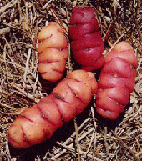
A compact, attractive, bushy perennial plant with clover-like leaves to 20 - 30 cm high. Oca tubers look like stubby, wrinkled carrots. It is suited to some temperate areas and will tolerate high altitudes. It is definitely not suitable to subtropical or tropical climates over summer. Oca is resistant to low temperatures and thrives in moderately cool climates but freezing will kill the foliage. If the tubers are already established it will re-sprout. Temperatures above 28°C cause the plant to wilt. Tubers start forming 4 months after planting and production peaks at 6 months. It tolerates a wide range of soil types and pH.
USES
Oca uses are similar to a potato i.e. oca can be boiled, baked or fried. In Mexico, oca is commonly sprinkled with salt, lemon and hot pepper and eaten raw. It is also made into pickles with vinegar. In the Andes, the tubers are placed in the sun for a few days, to sweeten them. The leaves can be eaten as a sorrel substitute. Oca can also be used as a pig forage; tubers and foliage are relished by pigs.
 PLANTING DETAILS
The recommended planting time is spring in cool areas and at the beginning of the wet season in warmer areas. To plant cover the tubers with soil to a depth of 5 cm; space plants 30 cm apart. Oca plants should be hilled like potatoes to encourage tuber formation, at about 4 months.
HARVEST
When the tubers are mature, the foliage starts to die back. Oca is more perishable than potatoes, but if properly handled can be stored at room temperature for some months. Store the best tubers for propagation the next season in dry sand or sawdust, in a cool dark place.
I live in Brisbane and really love oca, will it grow for me?
Answer: in order to successfully grow it, you need to 'reverse' the season. It stores remarkably well in a plastic bag in the crisper of the fridge. Buy it and store it until March. Winter temperatures in frost-free areas of Queensland are ideal to grow oca. The summer is simply too hot, humid and wet. Once you successfully grow your crop, save some of it in the fridge every year for autumn planting. It grows well in styrofoam boxes and planter bags, as well.
Not to NORFOLK ISLAND, NT, SA, TAS or WA
SORRY but due to quarantine restrictions between Australian States no plants at all can be ordered by residents of Norfolk Island, Tasmania and Western Australia. These restrictions are very important as they prevent the spread of plant pests and diseases. No potatoes, garlic, shallots, strawberries or tubestock can be sent to South Australia. No tubestock can be sent to Northern Territory.
Home
Green Harvest Organic Gardening Supplies is permanently closed as of 5pm on 1-11-2023.
We will not be taking orders by this website, in person, by phone or email. Our display garden and retail shop are closed forever.
Read more...
Phone:07 54357000
Phone calls will only be responded to sporadically and only in reference to orders placed prior to 2-11-2023. All the useful growing and organic pest management research and resources are available on this website for a while still.
DISCLAIMER:
No liability will be accepted by Green Harvest, its owners or employees as to the accuracy of any information. No responsibility will be taken for damage to property or persons due to information given about a product or technique. No responsibility will be taken for the loss of a crop or income due to information given about a product or technique.
 Shopping here is private and secure.
Copyright © 2001 - 2024 Green Harvest Organic Gardening Supplies
No part of this website may be reproduced without permission of the owner
SORRY but due to quarantine restrictions between Australian States no plants at all can be ordered by residents of Norfolk Island, Tasmania and Western Australia. These restrictions are very important as they prevent the spread of plant pests and diseases. No potatoes, garlic, shallots, strawberries or tubestock can be sent to South Australia. No tubestock can be sent to Northern Territory.
Home
Green Harvest Organic Gardening Supplies is permanently closed as of 5pm on 1-11-2023.
We will not be taking orders by this website, in person, by phone or email. Our display garden and retail shop are closed forever.
Read more...
Phone:07 54357000
Phone calls will only be responded to sporadically and only in reference to orders placed prior to 2-11-2023. All the useful growing and organic pest management research and resources are available on this website for a while still.
No liability will be accepted by Green Harvest, its owners or employees as to the accuracy of any information. No responsibility will be taken for damage to property or persons due to information given about a product or technique. No responsibility will be taken for the loss of a crop or income due to information given about a product or technique.
Shopping here is private and secure.
Copyright © 2001 - 2024 Green Harvest Organic Gardening Supplies
No part of this website may be reproduced without permission of the owner