| Organic Seeds | Edible Plants | Organic Pest Controls | Books | Tools, Propagation & Fertilisers | Sprouting & Microgreens | Poultry Supplies | Specials & Gift Ideas |

Top

We will send an email to this address*
when is next available
* we will use this email address only for this notification and then we will delete it.
 Home
Home
Green Harvest Organic Gardening Supplies is permanently closed as of 5pm on 1-11-2023.
We will not be taking orders by this website, in person, by phone or email. Our display garden and retail shop are closed forever.
Read more...
Phone:07 54357000
Phone calls will only be responded to sporadically and only in reference to orders placed prior to 2-11-2023. All the useful growing and organic pest management research and resources are available on this website for a while still.
 AVAILABLE FOR PURCHASE:
buy or get emailed when available
AVAILABLE FOR PURCHASE:
buy or get emailed when availableSTRAWBERRY GROWING INFORMATION © Frances Michaels
BOTANICAL NAME: Fragaria x ananassa
FAMILY: Rosaceae, the rose family
This information is for main crop strawberries such as 'Lowanna' and 'Joy', which need to be replanted every second year. It covers the process of rotating your beds so you have a bountiful strawberry harvest every year.
Ever-bearer or Alpine types simply need a rich, fertile, well-drained soil with adequate watering through their growth cycle.
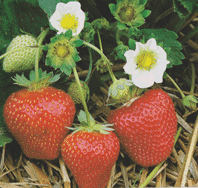
For the home gardener, being able to harvest bowlfuls of fresh, juicy, organic strawberries early in the morning for breakfast is a great motivator but keep in mind if there are kids involved, very few may actually make it back to the kitchen. Growing your own strawberries is easy to achieve with the right approach.
We tend to think of strawberries as perennials but in fact they only produce for 2 to 3 years.
Commercially the entire plant is replaced every year because the plants are most productive in the 1st year and the runners are time consuming to deal with.
WHEN
In subtropical areas March - April is the best planting time. In cooler areas the recommended planting time is late winter or early spring. Make sure the strawberry crowns (tops of the roots) are at soil level or they will rot. Water well regularly after planting. Do not allow the plants to dry out before new roots are established.
SPACING
Plant the runners 35 cm apart in a staggered fashion with 35 cm between rows.
WHERE
Choose an open, sunny position for the strawberry bed as good airflow will reduce fungal problems such as grey mould. Raised beds are best: the drainage is improved; the raised sides act as a barrier to crawling invaders such as slugs and snails; also it is a little bit easier to pick the fruit, weed and remove runners.
Consider the size and shape of the beds before planting, as birds are just as keen on strawberries as we are and you may need to net the strawberry bed. It is easier to do this if you have matched the size of your bed to available netting. Using a series of hoops or a frame to hold the net well above the plants keeps the air flow open. Just covering the plants without a support often leads to more fungal problems in humid weather.
SOIL
Strawberries prefer a well-drained soil, rich in humus. About a month before planting dig in lots of organic matter, compost, animal manure or blood and bone.
Keep the beds well mulched, to control weeds and keep the fruit clean. Pine needles have often been used as this mulch is acid and strawberries prefer a slightly acidic soil with a pH of 5.0 - 6.0. Avoid soil that has previously grown other berries or members of the tomato family (Solanaceae) to reduce the danger of viral diseases.
WATERING
Strawberries require plenty of water but hate wet leaves so laying drip irrigation or 'leaky pipe' is well worth the time and effort. Try not to use overhead watering. A fortnightly spray with seaweed fertiliser improves the vigour of the plants.
MAINTENANCE
Runner removal is an important part of strawberry bed maintenance. The runners, if left, tend to overcrowd the bed so that in the 2nd year the original strawberry bed is too crowded to be very productive at all. It takes time to do this annual clean-up and replenishment of the strawberry beds but it will reward you with a large crop. It is common to see strawberry beds left to become overcrowded in the garden with 2 or 3 years worth of runners fighting for space, but these beds produce very few strawberries. The original planting should have been certified virus-free stock and it is worth starting again with fresh virus-free stock 4 to 7 years down the track. If you have the space, then plan for 3 beds over time with crop rotation being practiced to reduce disease problems.
Bed 1:
Prepare the bed and plant certified virus-free runners. These will be highly productive but will also produce runners; pinch off the early runners to improve fruit production. After fruiting has finished these runners should all be removed along with any old or diseased leaves. Make sure the crown of the plant has not become buried by the mulch. The plants should be fed with compost and fresh mulch applied. They will then crop again the following year but not as heavily.
Bed 2:
If there is room in the garden, Bed 2 should be planted with the largest and healthiest runners from Bed 1. This will be more productive than Bed 1 when they crop the following season.
Bed 3:
Repeat the process again in following years. It is time after cropping twice to remove Bed 1 altogether as it will be exhausted; a 3rd crop is not usually worthwhile in terms of return. It is best to remove the plants and compost them. For disease control, practice crop rotation and do not plant strawberries again in this bed for a few years. Bed 3 can be created with the runners from Bed 1 or 2 in this season.
This method of growing strawberries will give you abundant crops of strawberries from your initial purchase.
PEST AND DISEASE PROBLEMS
Insect pests include thrips, two-spotted mite, caterpillars, curl grubs and Rutherglen bugs. Slugs and snails can also seriously affect the crop so place snail traps in the bed. The sides of raised beds can be sprayed with a snail and slug repellent such as Escar-Go to prevent access or protected with Copper Tape. For birds the main choices are Bird Netting or Bird Scare Flash Tape. Fungal problems such as grey mould and black spot are common in humid weather; regular use of a Natrakelp seaweed spray will help.
Not to NORFOLK ISLAND, NT, SA, TAS or WA
SORRY but due to quarantine restrictions between Australian States no plants at all can be ordered by residents of Norfolk Island, Tasmania and Western Australia. These restrictions are very important as they prevent the spread of plant pests and diseases. No potatoes, garlic, shallots, strawberries or tubestock can be sent to South Australia. No tubestock can be sent to Northern Territory.
Home
Green Harvest Organic Gardening Supplies is permanently closed as of 5pm on 1-11-2023.
We will not be taking orders by this website, in person, by phone or email. Our display garden and retail shop are closed forever.
Read more...
Phone:07 54357000
Phone calls will only be responded to sporadically and only in reference to orders placed prior to 2-11-2023. All the useful growing and organic pest management research and resources are available on this website for a while still.
DISCLAIMER:
No liability will be accepted by Green Harvest, its owners or employees as to the accuracy of any information. No responsibility will be taken for damage to property or persons due to information given about a product or technique. No responsibility will be taken for the loss of a crop or income due to information given about a product or technique.
 Shopping here is private and secure.
Copyright © 2001 - 2024 Green Harvest Organic Gardening Supplies
No part of this website may be reproduced without permission of the owner
SORRY but due to quarantine restrictions between Australian States no plants at all can be ordered by residents of Norfolk Island, Tasmania and Western Australia. These restrictions are very important as they prevent the spread of plant pests and diseases. No potatoes, garlic, shallots, strawberries or tubestock can be sent to South Australia. No tubestock can be sent to Northern Territory.
Home
Green Harvest Organic Gardening Supplies is permanently closed as of 5pm on 1-11-2023.
We will not be taking orders by this website, in person, by phone or email. Our display garden and retail shop are closed forever.
Read more...
Phone:07 54357000
Phone calls will only be responded to sporadically and only in reference to orders placed prior to 2-11-2023. All the useful growing and organic pest management research and resources are available on this website for a while still.
No liability will be accepted by Green Harvest, its owners or employees as to the accuracy of any information. No responsibility will be taken for damage to property or persons due to information given about a product or technique. No responsibility will be taken for the loss of a crop or income due to information given about a product or technique.
Shopping here is private and secure.
Copyright © 2001 - 2024 Green Harvest Organic Gardening Supplies
No part of this website may be reproduced without permission of the owner