| Organic Seeds | Edible Plants | Organic Pest Controls | Books | Tools, Propagation & Fertilisers | Sprouting & Microgreens | Poultry Supplies | Specials & Gift Ideas |

Top

We will send an email to this address*
when is next available
* we will use this email address only for this notification and then we will delete it.
 Home
Home
Green Harvest Organic Gardening Supplies is permanently closed as of 5pm on 1-11-2023.
We will not be taking orders by this website, in person, by phone or email. Our display garden and retail shop are closed forever.
Read more...
Phone:07 54357000
Phone calls will only be responded to sporadically and only in reference to orders placed prior to 2-11-2023. All the useful growing and organic pest management research and resources are available on this website for a while still.
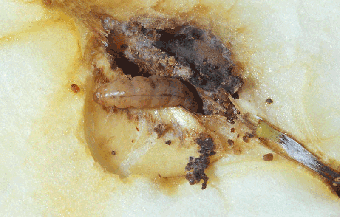 Everyone knows the old joke: what is worse than finding a worm in your apple? Answer: Half a worm. The saying
refers to the larva of the Codling Moth (Cydia pomonella), which originated in Europe but is now found
in most countries that grow apples. It also attacks pears, nashi pears, quinces, and occasionally walnuts and
stone fruits.
Everyone knows the old joke: what is worse than finding a worm in your apple? Answer: Half a worm. The saying
refers to the larva of the Codling Moth (Cydia pomonella), which originated in Europe but is now found
in most countries that grow apples. It also attacks pears, nashi pears, quinces, and occasionally walnuts and
stone fruits.Suggested Organic Strategies:
- Inspect the fruit every 10 days and remove and destroy infested fruit. Do not bury or place the fruit in compost heaps. It must be burnt or fed to animals, try cooking it in a sealed black plastic bag in the sun. If possible have poultry or other animals free-ranging under the trees to eat any fallen fruit.
- Remove any pieces of flaking bark, broken branches and litter from the crotch of the tree, to reduce hiding places for cocoons.
- Remove ladders, old boxes and tree props from the orchard, first checking them for cocoons.
- The most important natural enemy of the codling moth is the Trichogramma wasp, which parasitises the moth eggs. As an adult this micro wasp feeds on insect eggs, nectar, pollen and honeydew. It lives several times longer and destroys many more pests when supplied with nectar. Properly managed cover crops are the key to maintaining high levels of predatory insects.
- A horticultural glue around the trunk of the tree will prevent the movement of some of the female moths from the ground into the tree, as they tend to crawl and flutter up the branches. It should be in place from the first moth sighting until mid-winter. Using the glue below the corrugated cardboard bands will also help to force the larvae looking for a pupation site into the cardboard bands, as it will make it more difficult for them to reach the ground.
Organic Strategies for Codling Moth Control © Frances Michaels
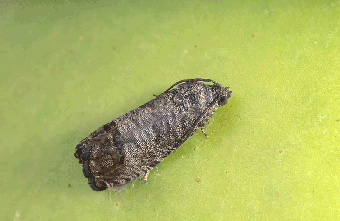 Vigilance is upmost in preventing codling moth damage.
Codling moth photos courtesy of Denis Crawford of Graphic Science
Life Cycle
In early spring the moths emerge about the time the fruit trees are in full bloom. Tiny, pinhead-sized eggs are laid by each female moth after dusk - usually on leaves - once the temperature is 15°C or higher. The eggs hatch in about 10 days. The tiny caterpillars may feed on leaves for a while before moving into the fruit. The caterpillar chews its way into the fruit core, where it feeds for three to five weeks. When it leaves the fruit and moves down the trunk and branches, it searches for a suitable place to spin a cocoon. This might be under loose bark, in a crevice, or in the ground. As the weather begins to cool, the last larvae do not pupate immediately but remain in thick, silken cocoons for some months. There are usually two to three generations a year in Australia.
Control measures need to take into consideration whether the pest problem is well-established with a high number of pests present, or whether it is a new orchard with a relatively small pest population. Other host plants nearby such as crabapple or ornamental pear can limit the effectiveness of some strategies. The most useful strategy of all is to keep the trees small so the fruit can easily be checked for damage, good spray coverage is possible and covering the fruit with bags does not involve risking life and limb on a ladder. For new orchards it is best to only plant fruit trees on dwarf or semi-dwarf rootstock. Choosing early-maturing varieties of apples will avoid a third-generation of codling moth, when pest numbers will be at their peak.
Biological Controls
- The most important natural enemy of the codling moth is the Trichogramma micro wasp, which parasitises the moth eggs. The wasp larva then feeds on the contents of the moth egg. Micro wasps are tiny, less than half a millimetre long and not hazardous to people in any way, instead they rank as one of the most beneficial insect in our gardens. One female wasp is able to parasitise over 50 moth eggs. Trichogramma wasps are commercially produced in Australia. Other pests controlled by micro wasps include: Tomato budworm, corn ear worm, Oriental fruit moth, lightbrown apple moth, cabbage moth and loopers. Trichogramma wasps are available commercially from Bugs for Bugs Qld www.bugsforbugs.com.au
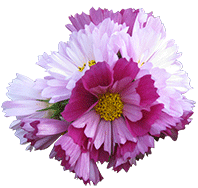
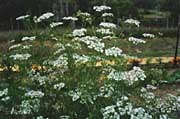
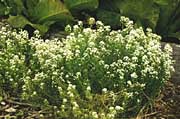
- The adult Trichogramma micro wasp feeds on insect eggs, nectar, and pollen, and a good food supply means it lives longer. Growing flowering plants in the orchard as a pollen and nectar source helps to maintain a population of these beneficial insects. Suitable insectary plants include clover, buckwheat, mustard, Queen Anne's lace, parsnip, daikon, alyssum, dill, coriander, cosmos and phacelia. Seed mixes of insectary plants are available commercially such as Good Bug Mix.
- Other natural enemies of codling moth include tachinid flies, ichneumon wasps, braconid wasps, chalcid wasps, carabid beetles, predatory bugs, green and brown lacewings, ladybirds, earwigs and ants. Spiders eat codling moth eggs, moths and larvae. Higher predation of codling moth larvae by carabid beetles has been observed in orchards with significant amounts of leaf litter and mulch.
- Night flying birds, tree frogs and small insectivorous bats will also reduce moth numbers. Small insectivorous bats weighing only 150 g when fully grown, can eat about a third of its own body weight in insects every night. In many parts of the world, organic farmers install bat boxes throughout their farms to encourage this natural form of pest control.
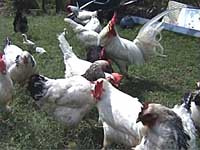
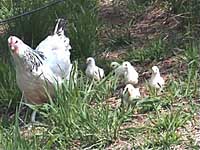
- Design your orchard area to be a poultry forage system. The chooks will turn damaged fruit into eggs and help to control a wide range of pests including codling moth. Instead of you having to pick up and dispose of damaged fruit, the chooks will do it for you. Do not introduce poultry into a young orchard, as the poultry will scratch at the mulch, exposing the roots. Where it is undesirable to allow chooks free range, small demountable fences can be used under specific trees.
- The apple season is a peak time to work on your organic strategies for codling moth. Inspect the trees every 10 days, collect any fruit you find with small holes and destroy it by immersing it in water for several days.
- Remove loose bark and leaf debris from the branches and crotch of the tree, to reduce hiding places for cocoons. This forces the caterpillars to find somewhere to pupate in the soil or leaf litter at the base of tree where they are more vulnerable to predators such as the carabid beetle or a scratching chicken. Corrugated cardboard bands can be placed around trunks and limbs to trap caterpillars looking for a place to pupate. Inspect every three weeks and destroy any cocooned caterpillars. The most important trapping time is during winter and spring, but for effective control inspect the bands all year round. Only use this method if you are likely to remember to regularly inspect and destroy the cocoons.
- Every year do a winter clean-up of the orchard by removing loose bark and follow this with an Eco Oil spray, to destroy over-wintering codling moth larvae. Make sure the trees are well mulched but keep the mulch away from the actual bark of the tree. The mulch provides habitat for ants, spiders and predatory ground beetles, all of whom feed on codling moth larvae. Remember to check storage areas, particularly apple crates for over-wintering cocoons.
- Open-mouthed jars can be filled with a variety of baits to attract codling moth. Try port diluted with water (1 part port to 9 parts water), fermenting apple juice, molasses or oil of cloves. Add a film of vegetable oil to the top to stop moths from escaping and prevent mosquitoes breeding. Hang them in trees in the warmest part of the orchard. Studies have shown codling moth prefer a bait four to five days old. Replace the baits every two weeks.
- A good choice for the home gardener with only a few apple trees is to bag the fruit, as this has been shown to give excellent control. Commercial exclusion products are available as nylon 'sockettes' sold as Nylon Pouches. It can be difficult to bag certain varieties with very short stems such as Gravenstein, try using mesh sleeves instead or a fruit fly net over the tree. Bags should be placed over the fruit while it is very small, usually about four to six weeks after flowering. First, thin the fruit to one piece per cluster. It is a good idea to spray (see below) before bagging to kill any small caterpillars already present. Bags should be removed four days before harvesting to allow the fruit to develop a stronger red colour. A big advantage to exclusion is it usually helps deal with bird and possum problems as well.
- Black-light traps have been used in the past to attract both male and female moths and can be effective as a monitoring aid and to reduce numbers.
A spray program is only effective if it is timed correctly with two aims:
1.
To kill the tiny caterpillars before they enter the fruit. This spraying should start 17 to 21 days after
full bloom, which is about 10 days after petal fall.
2. To kill the adult moths hiding on the tree. This spraying can begin at petal fall. Spray under the foliage and in bark crevices where the moths may be hiding.
It is worthwhile to spray before bagging the fruit, especially if the pest problem was significant in the
previous year's crop. If you are using a
Codling Moth Pheromone Trap
and are catching moths, then this is the best guide of when to begin spraying. Spraying too early will adversely
affect pollination by bees and may kill them.
2. To kill the adult moths hiding on the tree. This spraying can begin at petal fall. Spray under the foliage and in bark crevices where the moths may be hiding.
- Dipel, often called Bt, contains bacteria, Bacillus thuringiensis, found in the soil. When eaten by caterpillars, they stop feeding and die. Bt is considered a 'safe' spray for humans and beneficial insects. Combining Bt with 1% Eco Oil may improve the effectiveness.
- Eco Oil can be used to smother codling moth eggs. It has other benefits as the adult moths will not want to land on a surface coated with oil. If combined with other products it will give better sticking and spreading over the foliage. Application rates vary but a consistent regimen of re-spraying may be necessary to control new eggs and to compensate for rain washing the oil off the surface of the leaves. Begin spraying at petal fall. Eco Oil has an enhanced formulation which helps to attract beneficial insects into the garden.
- Success Ultra contains Spinetoram, which is derived from a naturally occurring soil bacteria. It is considered safe for people with a low impact on most beneficial insects. Begin spraying at petal fall.
- Pyrethrum can be used to control the adult moths and to kill tiny caterpillars before they enter the fruit. Pyrethrum sprays will be harmful to beneficial insects as well.
- A pheromone is a non-toxic, species-specific scent produced by the female insect to attract the male.
Pheromones are a particularly useful control for codling moth as the moths do not travel very far - usually
under 60 metres ? and find each other entirely by scent.
Synthetic pheromones are used in two different ways:1. Pheromone sticky wing traps are used to monitor the mating activity of codling moth. They allow you to be aware of when codling moths become active, so that you can correctly time your spraying or bagging program.
2. Pheromones are also used for mating disruption. By using Isomate twist ties, the orchard area is saturated with pheromones, making it extremely difficult for codling moths to find each other in order to mate. This technique is only suitable for larger blocks of at least three hectares; it is unlikely to work well in a small orchard.
Bio-insecticide: a biological control is now available in Australia for commercial apple orchards and is considered an acceptable organic control, however, organic growers should check with their certifying organisation before using. Grandex is based on codling moth granulosis virus, it is highly selective, only targeting Codling moth and Oriental fruit moth. Currently it is not available for home gardeners.
Suggested Products:
Nylon Pouch
Codling Moth Trap
Dipel
Eco Oil
Horticultural Glue
Home
Green Harvest Organic Gardening Supplies is permanently closed as of 5pm on 1-11-2023.
We will not be taking orders by this website, in person, by phone or email. Our display garden and retail shop are closed forever.
Read more...
Phone:07 54357000
Phone calls will only be responded to sporadically and only in reference to orders placed prior to 2-11-2023. All the useful growing and organic pest management research and resources are available on this website for a while still.
No liability will be accepted by Green Harvest, its owners or employees as to the accuracy of any information. No responsibility will be taken for damage to property or persons due to information given about a product or technique. No responsibility will be taken for the loss of a crop or income due to information given about a product or technique.
 Shopping here is private and secure.
Copyright © 2001 - 2024 Green Harvest Organic Gardening Supplies
No part of this website may be reproduced without permission of the owner