| Organic Seeds | Edible Plants | Organic Pest Controls | Books | Tools, Propagation & Fertilisers | Sprouting & Microgreens | Poultry Supplies | Specials & Gift Ideas |

Top

We will send an email to this address*
when is next available
* we will use this email address only for this notification and then we will delete it.
 Home
Home
Green Harvest Organic Gardening Supplies is permanently closed as of 5pm on 1-11-2023.
We will not be taking orders by this website, in person, by phone or email. Our display garden and retail shop are closed forever.
Read more...
Phone:07 54357000
Phone calls will only be responded to sporadically and only in reference to orders placed prior to 2-11-2023. All the useful growing and organic pest management research and resources are available on this website for a while still.
Suggested Organic Strategies:
- Attract them to a pond or children's wading pool by floating pieces of yellow plastic in the water. Smaller traps can be made out of yellow buckets filled with water and a 10% molasses solution. Cover with a film of oil to deter bees and mosquitoes
- Get up early in the morning when they are very slow moving, handpick them or catch them in a butterfly net
- Cover plants with an exclusion fabric; it will also protect plants from other pests like fruit flies and caterpillars
- Birds are a major control, including domestic varieties such as chooks and guinea fowl
- Beneficial insects such as tachinid flies and parasitic wasps prey on grasshoppers. Plant a Good Bug Mix to provide a food source for the adult predators.
Organic Strategies for Grasshopper Control © Frances Michaels
 Regardless of where you live in Australia, the noise of crickets and grasshoppers is one of the background
sounds of hot summer nights. The 'song' is produced by the male to attract a mate.
Crickets, grasshoppers and locusts, as a group of insects, are distinguished by strong chewing mouthparts
and enlarged hind-legs designed for jumping.
Regardless of where you live in Australia, the noise of crickets and grasshoppers is one of the background
sounds of hot summer nights. The 'song' is produced by the male to attract a mate.
Crickets, grasshoppers and locusts, as a group of insects, are distinguished by strong chewing mouthparts
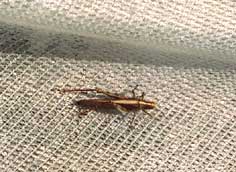
and enlarged hind-legs designed for jumping.Crickets are usually nocturnal. Some species, like the tree cricket, are predatory, while others, like the mole cricket, feed on roots and burrow in the soil.
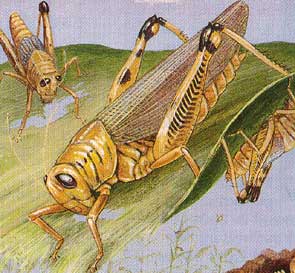
Grasshoppers are divided into short and long horned, with the 'horns' referring to the length of antennae. In long-horned grasshoppers the antennae are longer than the body. Long-horned grasshoppers are large, mainly plant eaters and often nocturnal. Short-horned grasshoppers, including the locusts, are active during the day.
The name locust is given to species that can occur in swarms. This includes the Australian plague locust, which has a black patch at the tip of the hind-wing and some scarlet on the hind-legs.
Not all grasshoppers are plant-eaters; surprisingly some are predatory with front legs adapted for grasping prey. Check before you accidentally squash a 'garden helper' by looking for spiny front legs.
Grasshopper eggs are mainly laid in the soil, although some do lay eggs on leaves. The eggs lay dormant until it rains, sometimes for years. Once hatched and if conditions are right, the next generation can be produced within a month.
Crickets, grasshoppers and locusts attack a wide range of plants, but it is in inland areas where the major impact is felt.
Biological Controls
- The most important natural enemies of grasshoppers are birds. In inland areas the ibis is particularly important as a control for locusts. As a result the draining of wetlands can increase locust plagues. You can attract birds to your garden by providing a source of water and safe nesting sites, free from predators and with privacy. Many small, insect-eating birds nest in the shrub layer rather than the tops of trees. Preferred nesting sites are dense plantings of native shrubs, especially prickly ones, in out-of-the-way corners of the garden. Make sure there are perches such as trellises or posts scattered throughout where birds can sit and watch for insect prey.
- Water is an essential element to improve biological control. Small ponds encourage useful predators such as frogs and dragonflies, which need water to breed. Frogs are very active nocturnal animals that devour large numbers of pests.
- Chickens not only like eating grasshoppers, but seem to get a lot of entertainment catching them too! Keen gardeners in inland areas should consider designing a chicken run with a shared fence between the chook run and vegetable garden for as much of the garden perimeter as possible. This can reduce the fencing needed and create a 'Fort Knox' style vegetable or flower garden as far as grasshoppers are concerned.
- Guinea fowl are hardy birds which eat large numbers of grasshoppers and ticks. Although their noisiness makes them unsuitable for urban areas, they could be a big help on larger properties.
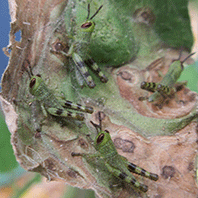
- Other creatures that prey on grasshoppers include lizards, spiders and predatory carabid and rove beetles. These can be encouraged by providing shelter such as rocks and hollow logs. Small rock cairns can look decorative in the garden and perform a valuable function of refuge for these predators. Baby grasshoppers hatch in spring and early summer from eggs hidden just below the soil surface. As they like to hide in dense areas of vegetation, they can easily become prey for hungry predators.
- Beneficial insects such as paper wasps, tachnid flies and parasitic wasps prey on grasshoppers. Robber flies are a major predator of grasshoppers, (up to a third of their diet). Habitat, such as a border of perennial plants, needs to be available all year round as a refuge for these predators. Growing flowering plants in the garden or orchard as a pollen and nectar source helps to maintain a population of these beneficial insects. Suitable insectary plants include clover, buckwheat, mustard, Queen Anne's lace, parsnip, daikon, alyssum, dill, coriander, cosmos and phacelia. Seed mixes of insectary plants are available commercially such as Good Bug Mix or Bed and Breakfast Seed Mix.
- There are a range of naturally occurring parasitic fungi species that attack and kill grasshoppers. These include: Nosema locustae, Beauveria spp., Lecanicillium spp. and Metarhizium spp.
- As a variation on the old adage 'the early bird catches the worm', this is also a good strategy with grasshoppers. Catching them in the early morning is relatively easy, as they are less active in the mornings, especially after a cool night. Either catch them by hand or use a butterfly net.
- Some gardeners use a border of tall, green grass around the outside of the garden to trap grasshoppers and (hopefully) divert them from vegetables or flowers. It only works if the trap crop is left un-mowed and doesn't dry out.
- Digging or cultivating in spring, and leaving the soil exposed, can expose the eggs to predators.
- Physical barriers such as floating row covers or mosquito netting work very well for early-season protection. This will also protect your plants from other pests like fruit flies and caterpillars. Sometimes exclusion is a lot of work initially but saves heaps of effort over time.
- The colour yellow is meant to be attractive to grasshoppers, so there are various ways this can be used to trap them. Long sticky tape traps are commercially available. Dams, ponds, or children's paddling pools can be used to drown grasshoppers by floating pieces of yellow plastic in the water, or suspending it from bamboo just above the water. Fish will happily eat the grasshoppers, or they could be collected and fed to chooks. You can try 'planting' a yellow bucket in the vege garden. Leave around 6 cm of yellow plastic showing above the mulch. The grasshoppers are attracted to the colour and will jump in but can't climb back out. Fill the bucket with water and a 10% molasses solution, cover the water with a film of canola oil to deter bees and mosquitoes.
- Canola oil has been found to be a grasshopper attractant, and can be used to make baits more attractive to grasshoppers - as with the above example. It could also be combined with organic insecticides to make them more effective, and floated as an oil on top of water traps.
- Insecticidal potassium soap sprays such as Natrasoap work best on small grasshoppers.
- Neem is a botanical insecticide made from extracts of the neem tree. Eco-Neem is a registered organic spray that controls a wide range of insects including grasshoppers. It works in multiple ways with the two main actions being suppression of insect appetite (they starve to death) and restricting growth (unable to moult successfully). It is approved in Australia for use on ornamental plants only but would be particularly useful sprayed on a trap crop of tall, lush grass.
- Pyrethrum insecticides are effective as a grasshopper control but also may kill beneficial insects. Spraying in the early morning or late afternoon will help to reduce the impact on non-target insects.
- Nutri-Life Myco-Force™ is available from Nutri-Tech Solutions as a probiotic to assist in the recovery of previously affected insect damaged plants. It contains naturally-occurring, bio-balancing fungal species including: Beauveria bassiana, Metarhizium anisopliae, and Lecanicillium lecanii.
- Make up a chilli spray as a repellent - see Home Made Chilli Spray box, below.
Organic farmers can take advantage of a biological control for locusts and grasshoppers based on a naturally occurring fungus Metarhizium. This breakthrough has meant that preventative control by the Plague Locust Commission can take place in environmentally sensitive areas without the problems caused by pesticide residues. It is marketed as Green Guard® but is not currently available in Australia in home garden size packs.
Suggested Products:
Eco-Neem
Exclusion Products
Pyrethrum
Yellow Sticky Roll Trap
Home
Green Harvest Organic Gardening Supplies is permanently closed as of 5pm on 1-11-2023.
We will not be taking orders by this website, in person, by phone or email. Our display garden and retail shop are closed forever.
Read more...
Phone:07 54357000
Phone calls will only be responded to sporadically and only in reference to orders placed prior to 2-11-2023. All the useful growing and organic pest management research and resources are available on this website for a while still.
No liability will be accepted by Green Harvest, its owners or employees as to the accuracy of any information. No responsibility will be taken for damage to property or persons due to information given about a product or technique. No responsibility will be taken for the loss of a crop or income due to information given about a product or technique.
 Shopping here is private and secure.
Copyright © 2001 - 2024 Green Harvest Organic Gardening Supplies
No part of this website may be reproduced without permission of the owner