| Organic Seeds | Edible Plants | Organic Pest Controls | Books | Tools, Propagation & Fertilisers | Sprouting & Microgreens | Poultry Supplies | Specials & Gift Ideas |

Top

We will send an email to this address*
when is next available
* we will use this email address only for this notification and then we will delete it.
 Home
Home
Green Harvest Organic Gardening Supplies is permanently closed as of 5pm on 1-11-2023.
We will not be taking orders by this website, in person, by phone or email. Our display garden and retail shop are closed forever.
Read more...
Phone:07 54357000
Phone calls will only be responded to sporadically and only in reference to orders placed prior to 2-11-2023. All the useful growing and organic pest management research and resources are available on this website for a while still.
 Organic Citrus Care © Frances Michaels
Citrus are native to Asia and are attractive, evergreen trees with fragrant blossoms. They are one of the most popular trees in the home garden but unfortunately unhealthy looking specimens are common, as their needs are not always understood. Citrus need regular feeding and attention paid to preventing pests and diseases.
One important rule for citrus is never grow it in the middle of the lawn, with grass right up to the trunk and expect it to thrive. The grass competes for water and nutrients and also releases allelopathic chemicals into the soil that diminish the vigour of the tree.
Planting
- In Queensland and warmer areas of NSW citrus can be planted in late winter or early spring but bare-rooted trees should only be planted in winter. In cooler areas spring is the best time for planting. Always remove any fruit on the young tree before planting, or better still select trees without fruit for more vigour.
- Choose an open, sunny position, preferably north to northeast facing, with shelter from strong winds. Wind can distort the shape of leaves with the damage becoming apparent months later.
- A fertile, well-drained soil with a pH between 6 - 8 is best. Citrus are vulnerable to root-rot so care must be taken to avoid badly drained areas. Ideally, prepare the soil several months ahead by digging over an area 1 m in diameter and at least 30 cm deep. Add compost (half a barrow load), 2 kg of gypsum to the m2 if the soil is heavy and 300 - 400 g of agricultural lime to the m2 if the soil is acidic (ph below 6.5). Mulch heavily and leave to decompose. If the drainage is poor it may be necessary to create a mound to plant on.
- When ready to plant dig the hole to twice the depth of the container and twice as wide. Add 1 kg of organic fertiliser to the bottom and work thoroughly through the soil with a fork. Then backfill the hole so that the tree will be at the same depth it was in the pot. Soak the tree, still in the container, for a couple of hours before planting, in water enriched with a small amount of seaweed (Natrakelp) fertiliser. Remove the tree from the container and gently tease out the roots so that they are not twisted together or circling. Trim off any damaged roots. Gently backfill with the soil, making sure there are no air pockets. Make sure the graft union is as high above the soil level as possible without exposing roots. Form a rim of soil about the same diameter as the container to aid in watering, so that water does not run off too fast. Give the tree a good soaking, remember to water again in a week but do not allow it to completely dry out. Mulch around the tree well, but keep the trunk free of mulch for about 10 cm.
 Feeding
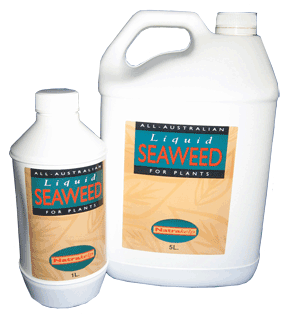
- Citrus trees are very hungry feeders with high requirements for trace elements. A regular spray with a seaweed fertiliser such as Natrakelp will supply trace elements. Fertilise citrus trees in April/May; always water the tree well after fertilising. Never place fertiliser close to the trunk or in heaps, spread it as evenly as possible to just past the drip-line of the tree. Compost or animal manures can be used starting with about 4 kg for a 1 year old tree to 20 kg for a mature 8 year old tree. In November/December apply agricultural lime or dolomite if necessary to correct the pH.
- Blood and bone contains mainly nitrogen and phosphorus, boost it into a more 'complete' fertiliser by adding a ¼ cup of sulphate of potash to every kilo of blood and bone.
- Citrus need regular watering from flower bud formation through to fruit set to retain a good crop.
- As they are relatively shallow-rooted, trees need even moisture throughout their root zone, water in the early morning or at night, especially during summer.
- Grass and weeds compete with your tree for water and nutrients, if left to grow long and rank under the tree they also encourage Collar Rot. Wet newspaper, at least 10 sheets thick, can be used to kill weeds and grass under the tree and then topped with mulch regularly to prevent weeds returning. Always mulch past the drip-line of the tree as this is the area where most of the feeder roots are found.
- Prune in June or July before the spring bud burst in frost-free areas. In frost affected areas delay pruning until after the last frost. Remove dead or damaged branches, branches growing inwards and very low branches to improve air circulation. After pruning, the lower edge of the canopy should be 60 - 90 cm clear of the ground. Always remove shoots from below the graft as soon as possible, as they steal vigour from the tree and if left too long, leave large wounds for disease to enter when they are cut.
- Aim to have mature trees no more than 2.5 - 3 m high. Higher than this just creates problems with harvesting and pest control. Larger trees are not more productive than smaller, well-managed trees. Shape the tree after harvest in early spring.
 Harvesting
- Only ever pick dry fruit. Lemons and limes should be picked 2 weeks before required as they become much easier to juice after this time. Use secateurs to cut citrus from the tree and trim close to the 'button' as leaving a sharp stalk causes damage to the skins of nearby fruit in storage, causing rot. If it is desirable to store lemons for long periods they should be picked just as they are turning yellow, wrapped loosely in paper and stored in an open cardboard box in a cool, dark, well-aired place.
- Practice good hygiene in orchard and never leave fruit to rot on the ground.
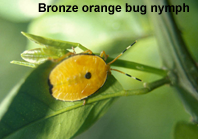
- Bronze orange bugs give away their presence by their foul smell. The young pale green nymphs appear in winter, their colour changes through orange to bronze as they grow to adults. They can be serious pests in some areas, causing flower and fruit drop by sucking on the stalks. Hand removal is possible, use a bucket of hot water to knock the bugs into. Wear protective goggles, long sleeves and gloves as the caustic fluid squirted by these bugs is very dangerous and painful, particularly to the eyes.
- The adult spined citrus bug has projecting horns on either side of its head, the young change colour from yellow through orange and finally to green. They attack the fruit, causing shedding of the young fruit and dry patches in mature fruit. Control by hand picking.
- Collar Rot is a soil fungus that attacks the tree trunk at ground level and if left untreated can kill the tree. The first signs of Collar Rot are splitting, oozing bark and yellowing foliage. Cutting the bark back with a sharp knife or chisel until undamaged bark is reached is the main treatment. Avoid wetting the trunk when watering and take steps to improve air circulation and soil drainage.
- Check for the characteristic lumps or galls of Citrus Gall Wasp on lemons and grapefruits on young branches and twigs in late winter. Prune off any affected twigs before August and burn. If there are tiny holes in the gall, then it is too late.
- Scab is a fungal disease that affects young fruit particularly lemons, causing raised light brown corky scabs on the fruit surface. Good hygiene and improving air circulation will help. More information on fungal disease.
- Citrus Leaf Miner causes ugly distorted leaves with silvery trails in the leaf tissue, especially in spring and summer. Eco Oil is a non-toxic control, spray when new growth is about 1 cm long and reapply every 2-3 weeks.
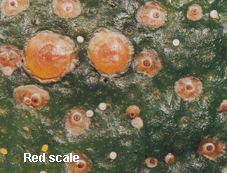
- Scale are sap-sucking insects with small,
round shells and are often found along the veins of leaves and the stems of plants. They look like small bumps and
can be mistaken for part of the plant, as adults do not move. Eggs are laid under the scale shell and immature
'crawlers' emerge. Crawlers can be moved around by wind, by ants, or by hitching a ride on a bird's leg. Scale in
large numbers cause leaf yellowing, leaf drop and dieback of twigs and limbs. In very large numbers red scale
(pictured) or white louse scale can seriously damage or kill young citrus trees.
To control white louse scale, spray with Lime Sulphur in winter, other scale outbreaks can be controlled with Eco-Oil, which works by smothering the scale.
Some soft scales, including white wax scale and black scale, secrete large amounts of 'honeydew', which causes problems by sticking to the lower leaves where it is fed on by a fungus called Black sooty mould.
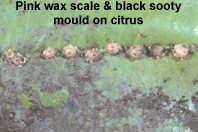 Honeydew also attracts ants, which feed on it. The
ants can 'farm' the scale, protect them from predators. So the first step is always to control any ants, as without
their protection the abundance of natural enemies in an organic garden will usually be able to keep scales under
control. Keep ants out of your trees by banding the trunks with
horticultural glue. Prune any low branches that
are touching the ground and make sure tall stems of grass aren't providing an alternative route for the ants.
Honeydew also attracts ants, which feed on it. The
ants can 'farm' the scale, protect them from predators. So the first step is always to control any ants, as without
their protection the abundance of natural enemies in an organic garden will usually be able to keep scales under
control. Keep ants out of your trees by banding the trunks with
horticultural glue. Prune any low branches that
are touching the ground and make sure tall stems of grass aren't providing an alternative route for the ants.
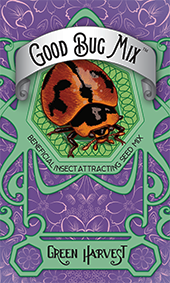
Improving the environment for the natural predators of scale is a long-term strategy that will pay off over time. Natural enemies of scale include ladybeetles, lacewings, spiders and tiny parasitoid wasps. Many beneficial insects that feed on garden pests need nectar and pollen for food during part of their lifecycle. Growing a year-round supply of suitable flowers such as Good Bug Mix will maintain beneficial insect populations throughout the year. Small insect-eating birds are also helpful in controlling scale; attract them by providing safe nest sites and a constant supply of water. - Black sooty mould is a fungus that feeds on honeydew. Honeydew is produced by a range of insects including aphid, scale, mealybug and planthopper. Sooty moulds makes a plant look unattractive and interferes with photosynthesis.
- Other pests of citrus include: spider mite, mealybug, aphid, whitefly, fruit fly and snails.

| Cultivars | Main Attributes | Frost Tolerant and Climate Zone | Prone To Fruit Fly | Ripening |
| Lemon Citrus limon | ||||
| Lisbon | Old variety, vigorous, thorniest lemon, few seeds. | Yes, best choice for cooler climates and dry areas. | Yes, in warmer months. | Heaviest crop in winter. |
| Eureka | Thornless, few seeds, not as hardy as the Lisbon to heat, cold, drought or disease. | Yes, good for warmer areas. | Everbearing so popular in home gardens, main crop winter. | |
| Villafranca | Less thorny than other lemons. | Subtropical climates. | Good summer crops in Qld. | |
| Meyer Botanically considered a cross between a lemon and orange. |
Not a true lemon, very thin-skinned, sweeter fruit; no thorns. | Yes, most cold tolerant lemon; very wide climate range, temperate to tropics. Best choice for the tropics, trees live longer. | Yes | All year but bulk of crop in November, December and January. |
| Lemonade | Lemon hybrid, very juicy, mild flavour, easily peeled. | Yes | ||
| Lime Citrus aurantifolia | ||||
| West Indian or Mexican or Key | Seedy, true lime taste. | No, tropical with a high heat requirement. | ||
| Tahitian or Persian | Seedless, nearly thorn-free. | Tolerates light frost, almost as cold tolerant as the lemon; prefers subtropical and tropical but will grow as far south as southern VIC. | ||
| Makrut | Leaves and fruit used in Asian cooking. | Tolerates light frost. | ||
| Pummelo Citrus maxima | ||||
| Bosred | Bigger and sweeter than grapefruit. | Yes, but flavour will be poor; subtropical and tropical zones. | ||
| Grapefruit Citrus paradisi | ||||
| Wheeny | Needs heat for a good flavour. | Yes, has a high heat requirement, taking 12-14 months to mature. | Yes | Late summer. |
| Marsh | Seedless, needs heat for a good flavour. | Yes | Qld March-August southern areas August-November. | |
| Red Fleshed Grapefruits Citrus paradisi | ||||
| Star Ruby or Flame or Rio Red | Seedless, much sweeter than Marsh, with less bitterness. | Great choice for warmer areas, does well in Queensland. | Mid April-June. | |
| Mandarin Seeded Citrus reticulata | ||||
| Page | Very popular home garden variety, good flavour. | Does well from Sydney to Brisbane. | Yes | Early |
| Nova | Thorny, sweet, fine flavour, red-orange skin colour. | Yes, Subtropical and Mediterranean. | Yes | Early April-May. |
| Fremont | Attractive red-orange skin, seedy, sweet, rich flavour. | Yes, Subtropical and Mediterranean. | Yes | Early April-June. |
| Imperial | Popular home garden variety, good flavour, easy to peel. | Most frost tolerant mandarin. | Yes | Early Late March-May; prone to biennial bearing; needs thinning. |
| Ellendale ('Beauty') Botanically a Tangor, a cross between mandarin and sweet orange. | Has problems with fruit split in some areas, stores well. Large fruit, good flavour and bright orange rind. | Yes, Subtropical and Mediterranean. | Yes | Late season Queensland June-Aug southern areas late July-late Sept; prone to biennial bearing. |
| Hickson | Very juicy; heavy crops, medium sized fruit. | Well-suited to coastal areas with high humidity. | Mid season May-July. | |
| Emperor ('of Canton') | Not as tasty as Imperial and Ellendale. | Better suited to inland areas; prone to rain damage. | Mid season (tropical areas April-June). | |
| Honey Murcott botanically probably a Tangor. |
A tangerine, delicious sweet fruit; prone to overbearing, fruit needs thinning. | Well suited to inland areas. | Queensland July-Sept; southern areas mid August to early October. | |
| Clementine Citrus reticulata | ||||
| Marisol, De Nules (best flavour) Fina, Oroval | Tighter skin than mandarins. Usually seedless but become seedy if grown close to Valencias. |
Early to mid season. | ||
| Orange - Navel Types
Citrus sinensis Avoid water stress Sept-Oct as few fruit will be set. |
||||
| Washington Navel | Seedless, needs less heat for a good flavour than other varieties. | Yes, Subtropical and Mediterranean. Not a good variety for the tropics, prone to damage by fruitpiercing moth. | May-June (tropical areas March-May). | |
| Newhall | Excellent quality. | Does well in subtropical areas. | Yes | Very early. |
| Navelina | Excellent quality. | Does well in subtropical areas. | April. | |
| Navelate | Excellent quality, easily peeled. | Does well in subtropical areas. | Late. | |
| Orange - Common Types Citrus sinensis | ||||
| Parramatta Sweet | Mid season. | |||
| Joppa | Very hardy and easy to grow; grown in Queensland for juice. | Mid season May-July. | ||
| Valencia | Nearly seedless, very juicy, holds well on the tree, crops over a longer period than navels. | High heat requirement, taking 12-14 months to ripen, crops well in subtropics. | Last to ripen (southern areas) September-April (tropical areas July-October). | |
| Blood oranges | Red flesh, very juicy and seedy. | Need a cool climate, not suitable for Queensland. | ||
| Tangelo Citrus x tangelo | ||||
| Minneola | Cross between a grapefruit and a mandarin, not very vigorous. | Performs better in Mediterranean areas. | Yes | |
 Suggested Products:
Lemon 'Eureka'
Lemonade
Makrut Lime
Tahitian Lime
Good Bug Mix
Seaweed (Natrakelp)
Horticultural Glue
Eco-Oil
Home
Green Harvest Organic Gardening Supplies is permanently closed as of 5pm on 1-11-2023.
We will not be taking orders by this website, in person, by phone or email. Our display garden and retail shop are closed forever.
Read more...
Phone:07 54357000
Phone calls will only be responded to sporadically and only in reference to orders placed prior to 2-11-2023. All the useful growing and organic pest management research and resources are available on this website for a while still.
No liability will be accepted by Green Harvest, its owners or employees as to the accuracy of any information. No responsibility will be taken for damage to property or persons due to information given about a product or technique. No responsibility will be taken for the loss of a crop or income due to information given about a product or technique.
 Shopping here is private and secure.
Copyright © 2001 - 2024 Green Harvest Organic Gardening Supplies
No part of this website may be reproduced without permission of the owner