| Organic Seeds | Edible Plants | Organic Pest Controls | Books | Tools, Propagation & Fertilisers | Sprouting & Microgreens | Poultry Supplies | Specials & Gift Ideas |

Top

We will send an email to this address*
when is next available
* we will use this email address only for this notification and then we will delete it.
 Home
Home
Green Harvest Organic Gardening Supplies is permanently closed as of 5pm on 1-11-2023.
We will not be taking orders by this website, in person, by phone or email. Our display garden and retail shop are closed forever.
Read more...
Phone:07 54357000
Phone calls will only be responded to sporadically and only in reference to orders placed prior to 2-11-2023. All the useful growing and organic pest management research and resources are available on this website for a while still.
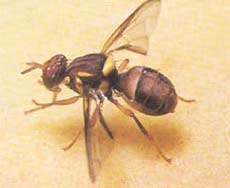 There are several pests described as 'fruit fly' in Australia. The main one in the eastern states is Queensland
fruit fly (Q fly) Bactrocera tryoni, which is native to rainforest habitat on the east coast of Australia.
Other pest fruit flies include the Mediterranean fruit fly (Med fly) Ceratitis capitata, an introduced
species currently only present in WA and the Cucumber fly Bactrocera cucumis. Cucumber fly is a major
pest of melons, pumpkins and zucchini, it is similar in appearance to Qld fruit fly but is a bit larger. The
fruits most commonly attacked by Q fly and Med fly are figs, cherries, stone fruit, apples, pears, loquats,
guavas, feijoas, tomatoes and capsicum. There are over 200 native species of fruit fly in Australia, only a
few are a problem for gardeners but can be a very significant one.
There are several pests described as 'fruit fly' in Australia. The main one in the eastern states is Queensland
fruit fly (Q fly) Bactrocera tryoni, which is native to rainforest habitat on the east coast of Australia.
Other pest fruit flies include the Mediterranean fruit fly (Med fly) Ceratitis capitata, an introduced
species currently only present in WA and the Cucumber fly Bactrocera cucumis. Cucumber fly is a major
pest of melons, pumpkins and zucchini, it is similar in appearance to Qld fruit fly but is a bit larger. The
fruits most commonly attacked by Q fly and Med fly are figs, cherries, stone fruit, apples, pears, loquats,
guavas, feijoas, tomatoes and capsicum. There are over 200 native species of fruit fly in Australia, only a
few are a problem for gardeners but can be a very significant one.Suggested Organic Strategies:
- Increase habitats for predators, such as ants, ground beetles, spiders and birds.
- Clean up all infected fruit as soon as possible. To destroy the maggots, immerse fruit in water or even better place in a pot, bring to the boil and then feed it to poultry, or try placing fruit in a sealed, black plastic bag in the sun.
- Use your orchard as a poultry forage area, to aid fruit fly control.
- Select early fruiting trees, to miss the onslaught of fruit fly.
- Grow dwarf varieties or keep trees small.
 Organic Fruit Fly Control © Frances Michaels
Fruit fly is responsible for more bad language from gardeners than any other pest. If you are lucky enough to live in a fruit fly free zone then count your blessings and do your bit to keep it that way. If you live in fruit fly zone, unless you are prepared to put in effort from year to year then a chainsaw may be your best solution. Fruit fly is a pest that needs a community approach; it could be the perfect opportunity to meet your neighbours for a street BBQ so you can plan a coordinated effort.
Lifecycle
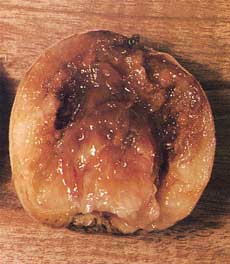
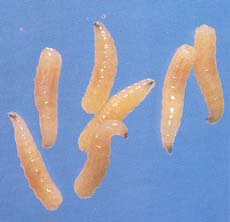
Queensland fruit fly develop from eggs to adults within five weeks in hot weather, whereas Med fly take only four weeks. Female flies only need to mate once or twice in their lifetime, and can lay several hundred eggs. The eggs are laid in small groups just beneath the skin of the fruit. The maggots hatch and, through their feeding and the bacteria they carry, cause the fruit to rot and drop. When the maggots are fully grown they leave the fruit and burrow into the soil, where they pupate. Both male and female flies feed on sugars and can live for many weeks, the flies commonly over-winter as adults, becoming active when the weather warms up around August. The population gradually builds to a peak in late summer.
 Physical and Cultural Controls
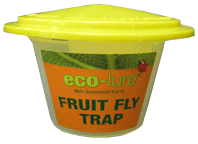
- Unfortunately we can expect fruit fly to become more of a problem as the climate changes. A milder winter will mean the problems start earlier with more generations occurring through the season. Monitoring male populations and spraying early will prevent their numbers escalating later in the season. Pheromone traps such as Eco-lure fruit fly traps can be hung in late winter to act as monitoring stations, these will attract and kill male Qld fruit flies and alert you so you can take further action.
- Once fruit is stung it is too late for anything but planning for a better result next year! You can check fruit for tiny dimples or weeping clear sap. Stung tomatoes will have tiny green spots on the skin as they ripen. Remove and destroy any stung fruit, it is more effective to do this straight away than picking up rotten fruit from the ground as the maggots may have already left the fruit to pupate.
- Destroy all infected fruit by immersing it in water for several days or by placing it in a sealed, black plastic bag in the sun, then try feeding it to poultry.
- Ideally it would be best to avoid planting fruit fly prone trees (see list below). If you really want to grow stone fruit, then dwarf trees or espalier trees will make management easier. A good rule of thumb when pruning stone fruit is that if you can?t reach it, cut it off.
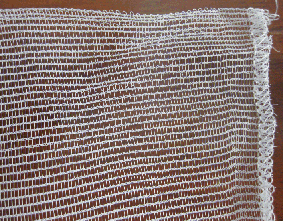
- The most effective organic solution for the home gardener is exclusion. This simply involves covering either the individual piece of fruit, fruit clusters, or the whole tree. Commercial fruit fly exclusion bags are available in polypropylene, waxed paper or cloth. In SE Asia, newspaper is glued to make a bag to cover fruit. Bags should be placed over the fruit as soon as it is formed. Thin the fruit at the same time. Excluding fruit fly from the entire tree is also possible by using a cover such as fruit fly netting or a lightweight fabric such as mosquito netting or shade cloth. It is best if covers are supported by a frame. Only leave the covers in place for the period that fruit is ripening to avoid damage to the tree. A big advantage to exclusion is it usually helps deal with bird and possum problems as well.
 Biological Controls
- Fruit fly has several predators - Braconid wasps are egg parasites; ants and ground beetles feed on the maggots; and spiders, dragonflies, robber flies and birds such as Swallows, Restless Flycatchers and Willy Wagtails eat the adult flies.
- Poultry is an enormous help in fruit fly control. If you design your orchard to incorporate chooks, they will reward you by turning rotten fruit into eggs and happily spend hours scratching beneath trees looking for fruit fly pupae. Adult fruit flies are trapped on the ground for up to 24 hours after emerging from the pupae, as it takes this long for their wings to harden. During this time the adult flies are also vulnerable to a roving chook. Where it isn't possible to allow chooks to free range, small demountable fences can be used under trees vulnerable to attack by fruit fly.
 Least Toxic Chemical Controls
Fruit fly is such a serious pest, capable of destroying 100% of the crop, so one product alone may not give sufficient control, especially if the pest population was high the previous season. Other factors that influence fruit fly population are if the orchard is within 5 km of rainforest, or it is a highly susceptible crop such as tomato, rows of vegetables, stone fruit or large mangoes. In this case a combination of strategies and controls may be needed. At the beginning of the fruit fly season a cover spray with a product containing pyrethrum or spinosad should help to reduce fruit fly to more manageable numbers before putting up baits or traps to catch female flies. The advantage of this combination, is that whereas repeated spraying with pyrethrum would damage beneficial insect populations, only using it initially will reduce its impact.
- Protein baits have been found to be most effective at capturing newly emerged adult females so having the traps up early is important.
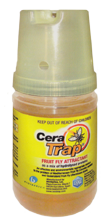
- Cera traps are used to trap Queensland (Qld) and Mediterranean (Med) male and female fruit fly in tree crops. It is not recommended for tomatoes. It comes as a ready-to-use jar filled with a protein-based liquid that is hung in a tree. Cera Traps contain no insecticide but most flies can't escape from the jar and drown in the liquid. Its effectiveness depends on having multiple traps around and throughout your crops.
- The web abounds with recipes for homemade traps but sadly research has found that less than 1-2 per cent of the insects caught in these traps are actually fruit fly. Even if fruit fly are caught, as there are over 250 native fruit fly species in Australia, only a few flies in the trap may be the ones responsible for stinging the fruit.
- Researchers in the USA have found that coffee bean juice from ground, ripe coffee berries have been a great success as a bait for female Med flies.
|
Avocado, avoid thin-skinned Fuerte and Rincon Bananas Blueberry, sometimes affected Citrus, avoid thin-skinned varieties such as Meyer lemon Custard Apple, winter ripening varieties are best Grapes, sometimes affected Grumichama Ice Cream Bean Jaboticaba Kiwifruit |
Longan and Lychee Macadamia Mulberry, sometimes affected Nashi Pears, sometimes affected Passionfruit Pawpaw Persimmon, early varieties like Fuyu are susceptible Pineapples Pomegranate |
Suggested Products:
Cera Trap
Mesh Bags
Mesh Sleeves
Insectrap
PestGuard Bags
Queensland Fruit Fly Traps
Stone Fruit Bags
Vege Net
Home
Green Harvest Organic Gardening Supplies is permanently closed as of 5pm on 1-11-2023.
We will not be taking orders by this website, in person, by phone or email. Our display garden and retail shop are closed forever.
Read more...
Phone:07 54357000
Phone calls will only be responded to sporadically and only in reference to orders placed prior to 2-11-2023. All the useful growing and organic pest management research and resources are available on this website for a while still.
No liability will be accepted by Green Harvest, its owners or employees as to the accuracy of any information. No responsibility will be taken for damage to property or persons due to information given about a product or technique. No responsibility will be taken for the loss of a crop or income due to information given about a product or technique.
 Shopping here is private and secure.
Copyright © 2001 - 2024 Green Harvest Organic Gardening Supplies
No part of this website may be reproduced without permission of the owner