| Organic Seeds | Edible Plants | Organic Pest Controls | Books | Tools, Propagation & Fertilisers | Sprouting & Microgreens | Poultry Supplies | Specials & Gift Ideas |

Top

We will send an email to this address*
when is next available
* we will use this email address only for this notification and then we will delete it.
 Home
Home
Green Harvest Organic Gardening Supplies is permanently closed as of 5pm on 1-11-2023.
We will not be taking orders by this website, in person, by phone or email. Our display garden and retail shop are closed forever.
Read more...
Phone:07 54357000
Phone calls will only be responded to sporadically and only in reference to orders placed prior to 2-11-2023. All the useful growing and organic pest management research and resources are available on this website for a while still.
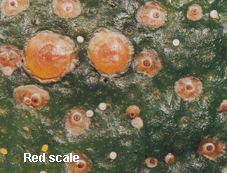 Scales are small sucking insects closely related to aphids, mealy bugs and whitefly. They tend to have small,
round shells and are often found along the veins of leaves and the stems of plants. Because they are small
and usually not moving, they often go unnoticed. Control of scales is important; as the damage they can cause
is out of all proportion to their size e.g. Californian red scale (pictured) can seriously damage or kill
small citrus trees.
Scales are small sucking insects closely related to aphids, mealy bugs and whitefly. They tend to have small,
round shells and are often found along the veins of leaves and the stems of plants. Because they are small
and usually not moving, they often go unnoticed. Control of scales is important; as the damage they can cause
is out of all proportion to their size e.g. Californian red scale (pictured) can seriously damage or kill
small citrus trees.Suggested Organic Strategies:
- Spraying to control the scale with Eco-Oil also loosens the black sooty mould making it easier to hose off.
- Important biological controls are tiny wasp parasitoids that lay their eggs in the scale. As the adult wasps feed on nectar, planting a Good Bug Mix will help feed the adults.
- Use a horticultural glue to keep ants out of your trees. This will make it a lot easier for the wasps to parasitise the scale.
Organic Strategies for Scale Control © Frances Michaels
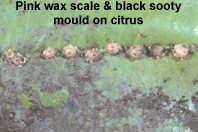 Common scales include black scale, pink wax scale, cottonycushion scale, San Jose scale, soft brown scale,
red scale and white louse scale. Scale look like small bumps and can be mistaken for part of the plant, as
adults do not move.
Common scales include black scale, pink wax scale, cottonycushion scale, San Jose scale, soft brown scale,
red scale and white louse scale. Scale look like small bumps and can be mistaken for part of the plant, as
adults do not move.Eggs are laid under the scale shell and immature 'crawlers' emerge. Crawlers can be moved around by wind, by ants, or by hitching a ride on a bird's leg. Scale in large numbers cause leaf yellowing, leaf drop and dieback of twigs and limbs. In very large numbers red scale can seriously damage or kill young citrus trees. Some scales secrete large amounts of 'honeydew', for example in a eucalyptus forest this can sometimes be seen as a gentle sticky rain. The honeydew causes problems by sticking to the lower leaves where it is fed on by a black fungus called 'sooty mould'. This makes a plant look unattractive and interferes with photosynthesis. Honeydew also attracts ants, which feed on it. The ants can 'farm' the scale, protecting it from predators.
Biological Controls
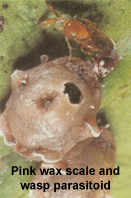 Enhancing the environment for the natural predators of scale is a long-term strategy with the benefits
increasing over time. Natural enemies of scale include ladybeetles, lacewings, spiders and tiny parasitoid
wasps (pictured). Many beneficial insects that feed on garden pests need nectar and pollen for food during
part of their lifecycle. Growing a year-round supply of suitable flowers will maintain beneficial insect
populations throughout the year, try planting a
Good Bug Mix. Small insect-eating birds are also
helpful in controlling scale; attract them by providing safe nest sites and a constant supply of water.
Try to keep any birds visiting your garden safe from cats.
Enhancing the environment for the natural predators of scale is a long-term strategy with the benefits
increasing over time. Natural enemies of scale include ladybeetles, lacewings, spiders and tiny parasitoid
wasps (pictured). Many beneficial insects that feed on garden pests need nectar and pollen for food during
part of their lifecycle. Growing a year-round supply of suitable flowers will maintain beneficial insect
populations throughout the year, try planting a
Good Bug Mix. Small insect-eating birds are also
helpful in controlling scale; attract them by providing safe nest sites and a constant supply of water.
Try to keep any birds visiting your garden safe from cats.Physical and Cultural Controls
The first step is always to control any ants, as without their protection the abundance of natural enemies in an organic garden will usually be able to keep scales under control. Keep ants out of your trees by banding the trunks with horticultural glues or grease bands. Prune any low branches that are touching the ground and make sure tall stems of grass aren't providing an alternative route for the ants. On indoor plants small colonies of scale can be rubbed off by hand, wear garden gloves and dip a toothbrush or a cotton bud in a soap solution. In the garden very heavily infested twigs can be pruned off, dropped into a bucket of soapy water, then composted or mulched.
Least Toxic Chemical Controls
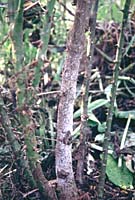 The best time to control scales is when the crawlers have recently emerged, as they are more vulnerable to
organic sprays than the adults with their thick shells. Correctly identifying the scale will help you to
time this exactly but mid-summer is common. Frenetic ant activity can indicate scale-hatching periods.
The best time to control scales is when the crawlers have recently emerged, as they are more vulnerable to
organic sprays than the adults with their thick shells. Correctly identifying the scale will help you to
time this exactly but mid-summer is common. Frenetic ant activity can indicate scale-hatching periods.Insecticidal soap sprays such as Natrasoap work by blocking the breathing pores and dissolving the scales' outer covering so they dehydrate and die. Commercial soap sprays are based on potassium and will not harm beneficial insects and have a very low toxicity to people or pets. Oil sprays such as Eco-Oil kill all stages of scale insects by suffocation which is a physical impact rather than a pesticidal action. It has a low impact on beneficial insects.
If you plan to spray, wait for settled weather with little wind and no rain. Spray in the early morning or late afternoon to avoid burning the leaves and to reduce the impact on beneficial insects. Wettable sulphur or lime sulphur can be sprayed in winter to control white louse scale on citrus.
Suggested Products:
Eco-Oil
Grease Bands
Horticultural Glue
Natrasoap
Pyrethrum
Home
Green Harvest Organic Gardening Supplies is permanently closed as of 5pm on 1-11-2023.
We will not be taking orders by this website, in person, by phone or email. Our display garden and retail shop are closed forever.
Read more...
Phone:07 54357000
Phone calls will only be responded to sporadically and only in reference to orders placed prior to 2-11-2023. All the useful growing and organic pest management research and resources are available on this website for a while still.
No liability will be accepted by Green Harvest, its owners or employees as to the accuracy of any information. No responsibility will be taken for damage to property or persons due to information given about a product or technique. No responsibility will be taken for the loss of a crop or income due to information given about a product or technique.
 Shopping here is private and secure.
Copyright © 2001 - 2024 Green Harvest Organic Gardening Supplies
No part of this website may be reproduced without permission of the owner