| Organic Seeds | Edible Plants | Organic Pest Controls | Books | Tools, Propagation & Fertilisers | Sprouting & Microgreens | Poultry Supplies | Specials & Gift Ideas |

Top

We will send an email to this address*
when is next available
* we will use this email address only for this notification and then we will delete it.
 Home
Home
Green Harvest Organic Gardening Supplies is permanently closed as of 5pm on 1-11-2023.
We will not be taking orders by this website, in person, by phone or email. Our display garden and retail shop are closed forever.
Read more...
Phone:07 54357000
Phone calls will only be responded to sporadically and only in reference to orders placed prior to 2-11-2023. All the useful growing and organic pest management research and resources are available on this website for a while still.
Improving Your Soil Organically © Frances Michaels
Compost
Legumes
Green Manure
Cover Crop
Mulch
Understanding pH
Soil Types
Crop Rotation
Organic Fertiliser
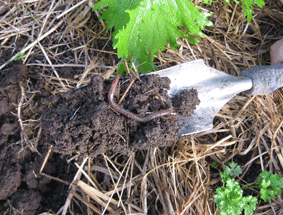 Healthy soils are a complex web of life, teeming with earthworms,
beneficial fungi and bacteria. They smell good and are moist and crumbly. Roots are able to penetrate easily,
deep into the soil. Plants growing in healthy soils have fewer pest and disease problems. If your soil doesn't match
this picture of health but instead dries out to a cement-like texture, is devoid of life, with plants that look sickly
and are plagued with pest problems, then your soil is in desperate need of organic matter. Using the following suggested
strategies will build organic matter levels and so improve the soil health.
Healthy soils are a complex web of life, teeming with earthworms,
beneficial fungi and bacteria. They smell good and are moist and crumbly. Roots are able to penetrate easily,
deep into the soil. Plants growing in healthy soils have fewer pest and disease problems. If your soil doesn't match
this picture of health but instead dries out to a cement-like texture, is devoid of life, with plants that look sickly
and are plagued with pest problems, then your soil is in desperate need of organic matter. Using the following suggested
strategies will build organic matter levels and so improve the soil health.
So what is organic matter? Simply anything that was once living: weeds, manure, hair, paper, kitchen scraps. Organic matter brings life to the soil, by providing food and habitat for beneficial microorganisms. As organic matter decomposes, through the activity of soil organisms, nutrients are made available to growing plants. Organic matter improves soil structure, allowing the free passage of air and water, both equally necessary to the growth of plants. It acts like a sponge, holding onto water and nutrients. Soils high in organic matter are like those you would find in an undisturbed moist, mountain forest and can actually feel spongy to walk on.
Australian soils are often very low in organic matter and nutrients; this is fine for a garden of native plants but needs to change if you want to grow fruit and vegetables that have evolved under very different soil conditions. There are many different ways of adding this all-important organic matter to our soils, from the recycling of food scraps and weeds, commonly known as composting, to the growing of crops specifically for organic matter production, referred to as green manuring. To protect our soils from erosion and summer heat we need to mulch them. This provides organic matter as it decomposes and also creates habitat for insect predators.
Compost
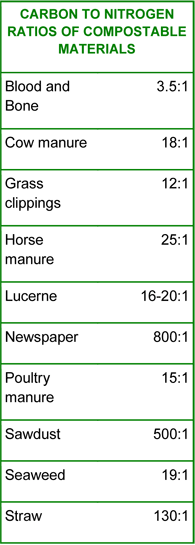 Understanding a Carbon to Nitrogen ratio (C : N) ratio will allow you to build successful compost heaps and use mulch
materials correctly. All organic materials such as manure, weeds, grass clippings and kitchen scraps have a C:N ratio.
The higher a material is in nitrogen the faster it will decompose, the higher it is in carbon the slower it will
decompose. The mix of materials in a compost heap needs a ratio of approx. 25 carbon to 1 nitrogen to break down successfully.
If the compost heap is too high in carbon it will not heat up, so you will need to add a source of nitrogen such as blood and
bone, chicken manure or urine. If it is too high in nitrogen, it will get hot very quickly but nutrients will be
lost as nitrogen converts to its gaseous form, ammonia. A general rule for compost heaps is 'if you can smell it, you
are losing it'. Add more carbon to prevent this such as straw, small amounts of sawdust or wet, shredded newspaper.
Understanding a Carbon to Nitrogen ratio (C : N) ratio will allow you to build successful compost heaps and use mulch
materials correctly. All organic materials such as manure, weeds, grass clippings and kitchen scraps have a C:N ratio.
The higher a material is in nitrogen the faster it will decompose, the higher it is in carbon the slower it will
decompose. The mix of materials in a compost heap needs a ratio of approx. 25 carbon to 1 nitrogen to break down successfully.
If the compost heap is too high in carbon it will not heat up, so you will need to add a source of nitrogen such as blood and
bone, chicken manure or urine. If it is too high in nitrogen, it will get hot very quickly but nutrients will be
lost as nitrogen converts to its gaseous form, ammonia. A general rule for compost heaps is 'if you can smell it, you
are losing it'. Add more carbon to prevent this such as straw, small amounts of sawdust or wet, shredded newspaper.
All organic materials will eventually rot, regardless of what you do. Composting is the art of producing rich, sweet smelling decomposed product rather than a wet, smelly, fly attracting, rotting mess. There are two main ways to go, using a bin or tumbler or building a compost heap. An enclosed bin is very useful for people with small backyards and has the advantage of being rat-proof. Management is necessary to get the right mix of carbon to nitrogen in bins. Kitchen scraps alone are generally too wet and too high in nitrogen. As each bucket is added a small amount of drier, high carbon material such as shredded newspaper or sawdust should be mixed in. Good compost will contain a range of ingredients, the wider the range, the more likely that a full range of nutrients will be included in the finished compost. Suitable ingredients include: cow, horse and poultry manure, comfrey and arrowroot leaves, legumes, wood ash, grass clippings, weeds (avoid adding weeds that have gone to seed), seaweed, kitchen scraps, leaves, hair, sawdust (small amounts only), feathers, soaked newspaper, animal bedding, fish waste and crop residues.
The completed compost heap should be as moist as a squeezed out sponge. If the heap is too dry, white threadlike strands will appear and fungi will become the main decomposers rather than bacteria. It should be covered to keep out rain, as it will become anaerobic if it gets wet and soggy. Place it in the garden to take advantage of any nutrient rich run-off, such as close to a citrus tree. Turning the heap speeds up the process and gives a more even result. A minimum size of about a cubic metre is needed for a heap to reach a sufficient temperature to kill weed seeds.
Never try to kill pests such as fruit fly in your compost heap as they are able to move away from the heat and complete their lifecycle. Avoid adding lime to compost heaps as this will increase the loss of nitrogen from the heap. Incorrectly stored animal manures can lose 50% of their nitrogen during storage. Always store manure undercover, using a tarp or old carpet to protect from rain and sun. If a compost heap is difficult to manage, simply tuck the food scraps under the mulch around fruit trees, it is still useful and will improve the soil over time. Worm composting bins work particularly well and can even be used in high rise buildings.
Legumes
Soil-building strategies like green manuring and cover cropping rely on a unique ability of a group of plants, the legumes, to 'fix' nitrogen. Plants such as clover, lucerne, peas and beans have an important advantage over other plants, of being able to obtain nitrogen, a major element needed for plant growth, from the soil air. They do this by forming a symbiotic relationship with a group of bacteria called rhizobium, which live within a specialised structure, called a nodule, on the plant's roots. The rhizobia can take nitrogen (N2) from the air and convert it to ammonium (NH4), the form of nitrogen plants normally obtain from the soil. This process is called nitrogen fixation.
Green Manure
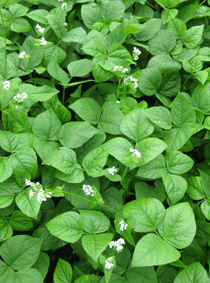 Green manures are a cornerstone of ecologically sustainable gardening. These are annual fast growing crops,
usually a legume combined with a grass, that are grown to build both organic matter and nitrogen levels to improve
the soil. This combination works well, the legume providing nitrogen and the grass the bulk of the organic matter.
'Grass' refers to a cereal grain such as barley, oats or sorghum, not a weedy running grass like couch or kikuyu.
When used in a crop rotation they can break disease cycles. They can provide outstanding benefits for the soil,
crop and you, the gardener by:
Green manures are a cornerstone of ecologically sustainable gardening. These are annual fast growing crops,
usually a legume combined with a grass, that are grown to build both organic matter and nitrogen levels to improve
the soil. This combination works well, the legume providing nitrogen and the grass the bulk of the organic matter.
'Grass' refers to a cereal grain such as barley, oats or sorghum, not a weedy running grass like couch or kikuyu.
When used in a crop rotation they can break disease cycles. They can provide outstanding benefits for the soil,
crop and you, the gardener by:
Chemical fertilisers supply nutrients but no organic matter, so these nutrients are easily lost to the soil to become pollution in our waterways. The major advantage green manuring has over the use of inorganic fertilisers is it provides a sustainable source of nitrogen, an essential plant element. Green manures also increase organic matter levels. This in turn increases soil life by providing a readily available food source to the decomposing organisms. Inorganic nitrogen fertilisers are often produced from fossil fuels by polluting processes, which contribute to the greenhouse effect.
More information on green manure
Cover Crops and Living Mulches
There is no existing word in the English language to describe 'a living carpet of perennial plants for use as an orchard groundcover' so at Green Harvest we use the term 'cover crop' or 'living mulch' to describe this. The key word here is 'perennial', as green manures are annual plants. A 'living mulch' of low-growing perennial legumes can provide many advantages to the health of your orchard. First of all it can replace the grass which aggressively competes with your fruit trees for water and nutrients. Cover crops can also reduce compaction caused by frequent mowing; bring deep minerals to the surface and break up hardpans; provide habitat, nectar and pollen for beneficial insects and reduce populations of pests; and improve water, root and air penetration in the soil.
Growing a cover crop is particularly easy in new orchards as the soil can be cultivated. The seed is then spread as evenly over the area as possible followed by raking to cover the seed. In established orchards cultivating would damage the tree roots so a variety of techniques may need to be used. Poultry in movable cages can be used to bare the ground, which is then sown with seed. Alternatively an organic herbicide can be used to kill any grass. Or an area can be mulched with newspaper and hay until the grass has died, then raked and sown with seed.
Mulch
Bare soil is a bad idea, it is vulnerable to erosion. Weeds are nature's answer to protect the earth, so always try to get in first with mulch. No-one needs the additional workload of weeding when planting and sowing is so much more satisfying. Mulch will also improve your soil by:
Using newspaper and cardboard as an initial layer of mulch will dramatically increase the period of time before weeds start to show through. A carpet of newspaper, part of the 'sheet mulch' technique, can be used where there are existing weeds and grasses, such as under a fruit tree. If the grass and weeds are long then start by mowing. Then spread an organic fertiliser or compost, make sure the soil is moist. Next tile the area under the tree with paper or cardboard, from the trunk to just past the dripline. This is a good way to reduce household waste paper entering the waste stream and instead return the carbon to the soil. Cover the scrap paper layer with mulch. There is no advantage to weeding first because the weeds will decompose and add to the organic matter. Even better, the roots of the weeds will decompose and add organic matter deeper down in the soil. The decomposed roots then become passageways through the soil for air and water to penetrate. Earthworms love the cardboard treatment and it encourages them to stay actively working to improve the soil for longer in the warmer weather rather than retreating to deeper, cooler areas.
More information on growing your own mulch
More information on rough mulch
More information on in-situ mulch
Understanding pH
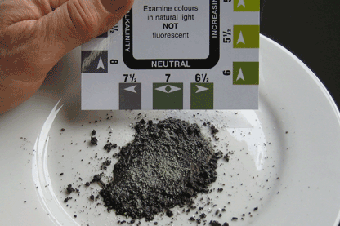 On very poor soils it may be difficult to grow anything, including a successful green manure crop. In this case
the pH should be tested for excessive acidity or alkalinity, as this will interfere with uptake of nutrients by
plants. pH is a measure of the acidity and alkalinity of the soil using a scale from 1 to 14; where 7 is neutral,
less than 7 is acid and greater than 7 is alkaline.
On very poor soils it may be difficult to grow anything, including a successful green manure crop. In this case
the pH should be tested for excessive acidity or alkalinity, as this will interfere with uptake of nutrients by
plants. pH is a measure of the acidity and alkalinity of the soil using a scale from 1 to 14; where 7 is neutral,
less than 7 is acid and greater than 7 is alkaline.
Fresh, clean water is neutral with a pH of 7, vinegar is very acid with a pH of 2.6 and baking soda is very alkaline with a pH of 8.5. It is important to remember that pH is a logarithmic scale, so the difference between a pH of 7 and a pH of 6 is 10 times the acidity, between 7 and 5 is a 100 times the acidity and between 7 and 4 is a 1000 times the acidity.
pH can be used as an indicator of the availability of nutrients in the soil. Acid soils with a pH of less than 6 commonly have deficiencies in calcium, magnesium, phosphorus, potassium, molybdenum. Acid soils with a pH of less than 4 commonly have toxic amounts of aluminium and manganese. Alkaline soils with a pH of more than 7 commonly have the following nutrients unavailable; iron, manganese, zinc, copper, boron.
Adjusting the pH will make these nutrients available to your plants. Organic matter will generally 'buffer' plants against the impact of acidity so that a soil with a lower pH range will still successfully grow plants. Plants vary in their desired pH range and this is to do with the pH of the soil type they evolved in. For example, lavenders are native to the limestone soils of the Mediterranean and so prefer an alkaline soil.
More information on soil pH
Soil Types
Clay soils are high in nutrients but can be poorly drained, hard to dig and compacted. Most clay soils will be improved by the addition of gypsum, apply it at a rate of 500g/m2. Gypsum (calcium sulphate) does not alter the pH of the soil but can improve aeration and reduce compaction in a clay soil. Avoid walking on or digging clay soils when wet. Keep well mulched and apply large amounts of organic matter. Over time, as the organic matter decomposes and earthworms proliferate, the soil will become lighter and easier to work. Green manures to particularly improve clay soils include: fenugreek, cowpea and lupins.
Sandy soils are easy to dig and well-drained but are low in nutrients and dry out quickly. Adding organic matter to act as a sponge and hold the nutrients and water in the soil is critical. Keep the soil well-mulched as the slow breakdown of nutrients helps buffer the impact of leaching. Sandy soils are worth the expense of a lucerne mulch. As the lucerne decomposes it will form a loamy topsoil on top of the sand. Over time earthworms will blend the layers creating a better soil. Green manures to particularly improve sandy soils include: buckwheat, millet, oats and woolly pod vetch.
Crop Rotation
Crop rotation is a useful strategy for vegetable gardens as it prevents the build-up of soil-borne diseases and balances nutrient uptake. This is the practice of growing vegetables from different plant families in beds the following year. So tomatoes, potatoes or eggplants would not follow each other as they all belong to the same plant family, Solanaceae. Sadly it is a garden myth that you should follow a crop of peas and beans with a heavy feeder like cabbage, because of all the nitrogen fixed by the legumes. This is true in Europe where these plants have originated but unfortunately not true in Australia where the symbiotic bacteria are generally not found in our soils, unless an inoculated crop, such as a green manure, has been grown within 3 years. Generally peas and beans grown as vegetables have the same need for nitrogen as any other crop and do not leave a residue of additional nitrogen for the next crop.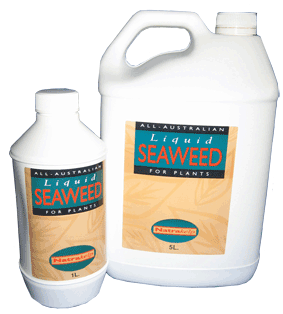
Organic Fertiliser
Many Australian soils are deficient in a range of macro and micronutrients, all equally necessary for plant growth. The addition of composted animal manures or products such as Dynamic Lifter, will increase the supply of macronutrients such as nitrogen, potassium and phosphate. Trace or micronutrients are only needed in small amounts but are just as important for healthy plants. Trace elements include calcium, magnesium, sulphur, iron, manganese, copper, zinc, boron and molybdenum. Initially in deficient soils it may be necessary to apply a trace element mix, but ongoing nutrients can be supplied by fish emulsion or a seaweed fertiliser such as Natrakelp
The aim in applying fertilisers is to create sufficient fertility for initial growth. During periods of continued heavy rain, the leaching of some nutrients is inevitable. To keep plants healthy and growing vigorously at these times, the application of seaweed fertiliser as a foliar feed is recommended.
Life is solar-powered, only plants can photosynthesise, transforming the sun's energy into carbohydrates
Healthy soils are a complex web of life, teeming with earthworms,
beneficial fungi and bacteria. They smell good and are moist and crumbly. Roots are able to penetrate easily,
deep into the soil. Plants growing in healthy soils have fewer pest and disease problems. If your soil doesn't match
this picture of health but instead dries out to a cement-like texture, is devoid of life, with plants that look sickly
and are plagued with pest problems, then your soil is in desperate need of organic matter. Using the following suggested
strategies will build organic matter levels and so improve the soil health.So what is organic matter? Simply anything that was once living: weeds, manure, hair, paper, kitchen scraps. Organic matter brings life to the soil, by providing food and habitat for beneficial microorganisms. As organic matter decomposes, through the activity of soil organisms, nutrients are made available to growing plants. Organic matter improves soil structure, allowing the free passage of air and water, both equally necessary to the growth of plants. It acts like a sponge, holding onto water and nutrients. Soils high in organic matter are like those you would find in an undisturbed moist, mountain forest and can actually feel spongy to walk on.
Australian soils are often very low in organic matter and nutrients; this is fine for a garden of native plants but needs to change if you want to grow fruit and vegetables that have evolved under very different soil conditions. There are many different ways of adding this all-important organic matter to our soils, from the recycling of food scraps and weeds, commonly known as composting, to the growing of crops specifically for organic matter production, referred to as green manuring. To protect our soils from erosion and summer heat we need to mulch them. This provides organic matter as it decomposes and also creates habitat for insect predators.
Compost
Understanding a Carbon to Nitrogen ratio (C : N) ratio will allow you to build successful compost heaps and use mulch
materials correctly. All organic materials such as manure, weeds, grass clippings and kitchen scraps have a C:N ratio.
The higher a material is in nitrogen the faster it will decompose, the higher it is in carbon the slower it will
decompose. The mix of materials in a compost heap needs a ratio of approx. 25 carbon to 1 nitrogen to break down successfully.
If the compost heap is too high in carbon it will not heat up, so you will need to add a source of nitrogen such as blood and
bone, chicken manure or urine. If it is too high in nitrogen, it will get hot very quickly but nutrients will be
lost as nitrogen converts to its gaseous form, ammonia. A general rule for compost heaps is 'if you can smell it, you
are losing it'. Add more carbon to prevent this such as straw, small amounts of sawdust or wet, shredded newspaper.All organic materials will eventually rot, regardless of what you do. Composting is the art of producing rich, sweet smelling decomposed product rather than a wet, smelly, fly attracting, rotting mess. There are two main ways to go, using a bin or tumbler or building a compost heap. An enclosed bin is very useful for people with small backyards and has the advantage of being rat-proof. Management is necessary to get the right mix of carbon to nitrogen in bins. Kitchen scraps alone are generally too wet and too high in nitrogen. As each bucket is added a small amount of drier, high carbon material such as shredded newspaper or sawdust should be mixed in. Good compost will contain a range of ingredients, the wider the range, the more likely that a full range of nutrients will be included in the finished compost. Suitable ingredients include: cow, horse and poultry manure, comfrey and arrowroot leaves, legumes, wood ash, grass clippings, weeds (avoid adding weeds that have gone to seed), seaweed, kitchen scraps, leaves, hair, sawdust (small amounts only), feathers, soaked newspaper, animal bedding, fish waste and crop residues.
The completed compost heap should be as moist as a squeezed out sponge. If the heap is too dry, white threadlike strands will appear and fungi will become the main decomposers rather than bacteria. It should be covered to keep out rain, as it will become anaerobic if it gets wet and soggy. Place it in the garden to take advantage of any nutrient rich run-off, such as close to a citrus tree. Turning the heap speeds up the process and gives a more even result. A minimum size of about a cubic metre is needed for a heap to reach a sufficient temperature to kill weed seeds.
Never try to kill pests such as fruit fly in your compost heap as they are able to move away from the heat and complete their lifecycle. Avoid adding lime to compost heaps as this will increase the loss of nitrogen from the heap. Incorrectly stored animal manures can lose 50% of their nitrogen during storage. Always store manure undercover, using a tarp or old carpet to protect from rain and sun. If a compost heap is difficult to manage, simply tuck the food scraps under the mulch around fruit trees, it is still useful and will improve the soil over time. Worm composting bins work particularly well and can even be used in high rise buildings.
Legumes
Soil-building strategies like green manuring and cover cropping rely on a unique ability of a group of plants, the legumes, to 'fix' nitrogen. Plants such as clover, lucerne, peas and beans have an important advantage over other plants, of being able to obtain nitrogen, a major element needed for plant growth, from the soil air. They do this by forming a symbiotic relationship with a group of bacteria called rhizobium, which live within a specialised structure, called a nodule, on the plant's roots. The rhizobia can take nitrogen (N2) from the air and convert it to ammonium (NH4), the form of nitrogen plants normally obtain from the soil. This process is called nitrogen fixation.
Green Manure
Green manures are a cornerstone of ecologically sustainable gardening. These are annual fast growing crops,
usually a legume combined with a grass, that are grown to build both organic matter and nitrogen levels to improve
the soil. This combination works well, the legume providing nitrogen and the grass the bulk of the organic matter.
'Grass' refers to a cereal grain such as barley, oats or sorghum, not a weedy running grass like couch or kikuyu.
When used in a crop rotation they can break disease cycles. They can provide outstanding benefits for the soil,
crop and you, the gardener by:
- Increasing organic matter, earthworms and beneficial micro-organisms.
- Increasing the soil's available nitrogen and moisture retention.
- Stabilising the soil to prevent erosion.
- Bringing deep minerals to the surface and breaking up hardpans.
- Providing habitat, nectar and pollen for beneficial insects and reducing populations of pests.
- Improving water, root and air penetration in the soil.
- Smothering persistent weeds; good choices for weed suppression include lablab, cowpea, lucerne and buckwheat.
Chemical fertilisers supply nutrients but no organic matter, so these nutrients are easily lost to the soil to become pollution in our waterways. The major advantage green manuring has over the use of inorganic fertilisers is it provides a sustainable source of nitrogen, an essential plant element. Green manures also increase organic matter levels. This in turn increases soil life by providing a readily available food source to the decomposing organisms. Inorganic nitrogen fertilisers are often produced from fossil fuels by polluting processes, which contribute to the greenhouse effect.
More information on green manure
Cover Crops and Living Mulches
There is no existing word in the English language to describe 'a living carpet of perennial plants for use as an orchard groundcover' so at Green Harvest we use the term 'cover crop' or 'living mulch' to describe this. The key word here is 'perennial', as green manures are annual plants. A 'living mulch' of low-growing perennial legumes can provide many advantages to the health of your orchard. First of all it can replace the grass which aggressively competes with your fruit trees for water and nutrients. Cover crops can also reduce compaction caused by frequent mowing; bring deep minerals to the surface and break up hardpans; provide habitat, nectar and pollen for beneficial insects and reduce populations of pests; and improve water, root and air penetration in the soil.
Growing a cover crop is particularly easy in new orchards as the soil can be cultivated. The seed is then spread as evenly over the area as possible followed by raking to cover the seed. In established orchards cultivating would damage the tree roots so a variety of techniques may need to be used. Poultry in movable cages can be used to bare the ground, which is then sown with seed. Alternatively an organic herbicide can be used to kill any grass. Or an area can be mulched with newspaper and hay until the grass has died, then raked and sown with seed.
- It is important to select both summer and winter vigorous ground covers to reduce weed invasion.
- Plant species should be selected for suitability to climate, ease of establishment, perennial habit, nitrogen-fixing capacity and shade tolerance.
- Avoid climbing legumes such as Lablab.
- Aim for a flowering meadow in your orchard rather than sterile, bare earth or a grass ground cover.
- Plant choices include Wynn's cassia, barrel medic, red clover, white clover, lucerne, subclover.
Mulch
Bare soil is a bad idea, it is vulnerable to erosion. Weeds are nature's answer to protect the earth, so always try to get in first with mulch. No-one needs the additional workload of weeding when planting and sowing is so much more satisfying. Mulch will also improve your soil by:
- retaining moisture in the soil
- keeping the soil from over-heating
- preventing erosion and improving soil structure
- feeding the soil as it breaks down
- reducing the spread of fungal disease spores
- very importantly it can create habitat for soil dwelling predators, e.g. ground beetles and centipedes that control pests see Rough Mulch
Using newspaper and cardboard as an initial layer of mulch will dramatically increase the period of time before weeds start to show through. A carpet of newspaper, part of the 'sheet mulch' technique, can be used where there are existing weeds and grasses, such as under a fruit tree. If the grass and weeds are long then start by mowing. Then spread an organic fertiliser or compost, make sure the soil is moist. Next tile the area under the tree with paper or cardboard, from the trunk to just past the dripline. This is a good way to reduce household waste paper entering the waste stream and instead return the carbon to the soil. Cover the scrap paper layer with mulch. There is no advantage to weeding first because the weeds will decompose and add to the organic matter. Even better, the roots of the weeds will decompose and add organic matter deeper down in the soil. The decomposed roots then become passageways through the soil for air and water to penetrate. Earthworms love the cardboard treatment and it encourages them to stay actively working to improve the soil for longer in the warmer weather rather than retreating to deeper, cooler areas.
More information on growing your own mulch
More information on rough mulch
More information on in-situ mulch
Understanding pH
On very poor soils it may be difficult to grow anything, including a successful green manure crop. In this case
the pH should be tested for excessive acidity or alkalinity, as this will interfere with uptake of nutrients by
plants. pH is a measure of the acidity and alkalinity of the soil using a scale from 1 to 14; where 7 is neutral,
less than 7 is acid and greater than 7 is alkaline.Fresh, clean water is neutral with a pH of 7, vinegar is very acid with a pH of 2.6 and baking soda is very alkaline with a pH of 8.5. It is important to remember that pH is a logarithmic scale, so the difference between a pH of 7 and a pH of 6 is 10 times the acidity, between 7 and 5 is a 100 times the acidity and between 7 and 4 is a 1000 times the acidity.
pH can be used as an indicator of the availability of nutrients in the soil. Acid soils with a pH of less than 6 commonly have deficiencies in calcium, magnesium, phosphorus, potassium, molybdenum. Acid soils with a pH of less than 4 commonly have toxic amounts of aluminium and manganese. Alkaline soils with a pH of more than 7 commonly have the following nutrients unavailable; iron, manganese, zinc, copper, boron.
Adjusting the pH will make these nutrients available to your plants. Organic matter will generally 'buffer' plants against the impact of acidity so that a soil with a lower pH range will still successfully grow plants. Plants vary in their desired pH range and this is to do with the pH of the soil type they evolved in. For example, lavenders are native to the limestone soils of the Mediterranean and so prefer an alkaline soil.
More information on soil pH
Soil Types
Clay soils are high in nutrients but can be poorly drained, hard to dig and compacted. Most clay soils will be improved by the addition of gypsum, apply it at a rate of 500g/m2. Gypsum (calcium sulphate) does not alter the pH of the soil but can improve aeration and reduce compaction in a clay soil. Avoid walking on or digging clay soils when wet. Keep well mulched and apply large amounts of organic matter. Over time, as the organic matter decomposes and earthworms proliferate, the soil will become lighter and easier to work. Green manures to particularly improve clay soils include: fenugreek, cowpea and lupins.
Sandy soils are easy to dig and well-drained but are low in nutrients and dry out quickly. Adding organic matter to act as a sponge and hold the nutrients and water in the soil is critical. Keep the soil well-mulched as the slow breakdown of nutrients helps buffer the impact of leaching. Sandy soils are worth the expense of a lucerne mulch. As the lucerne decomposes it will form a loamy topsoil on top of the sand. Over time earthworms will blend the layers creating a better soil. Green manures to particularly improve sandy soils include: buckwheat, millet, oats and woolly pod vetch.
Crop Rotation
Crop rotation is a useful strategy for vegetable gardens as it prevents the build-up of soil-borne diseases and balances nutrient uptake. This is the practice of growing vegetables from different plant families in beds the following year. So tomatoes, potatoes or eggplants would not follow each other as they all belong to the same plant family, Solanaceae. Sadly it is a garden myth that you should follow a crop of peas and beans with a heavy feeder like cabbage, because of all the nitrogen fixed by the legumes. This is true in Europe where these plants have originated but unfortunately not true in Australia where the symbiotic bacteria are generally not found in our soils, unless an inoculated crop, such as a green manure, has been grown within 3 years. Generally peas and beans grown as vegetables have the same need for nitrogen as any other crop and do not leave a residue of additional nitrogen for the next crop.
Organic Fertiliser
Many Australian soils are deficient in a range of macro and micronutrients, all equally necessary for plant growth. The addition of composted animal manures or products such as Dynamic Lifter, will increase the supply of macronutrients such as nitrogen, potassium and phosphate. Trace or micronutrients are only needed in small amounts but are just as important for healthy plants. Trace elements include calcium, magnesium, sulphur, iron, manganese, copper, zinc, boron and molybdenum. Initially in deficient soils it may be necessary to apply a trace element mix, but ongoing nutrients can be supplied by fish emulsion or a seaweed fertiliser such as Natrakelp
The aim in applying fertilisers is to create sufficient fertility for initial growth. During periods of continued heavy rain, the leaching of some nutrients is inevitable. To keep plants healthy and growing vigorously at these times, the application of seaweed fertiliser as a foliar feed is recommended.
Life is solar-powered, only plants can photosynthesise, transforming the sun's energy into carbohydrates
Home
Green Harvest Organic Gardening Supplies is permanently closed as of 5pm on 1-11-2023.
We will not be taking orders by this website, in person, by phone or email. Our display garden and retail shop are closed forever.
Read more...
Phone:07 54357000
Phone calls will only be responded to sporadically and only in reference to orders placed prior to 2-11-2023. All the useful growing and organic pest management research and resources are available on this website for a while still.
No liability will be accepted by Green Harvest, its owners or employees as to the accuracy of any information. No responsibility will be taken for damage to property or persons due to information given about a product or technique. No responsibility will be taken for the loss of a crop or income due to information given about a product or technique.
 Shopping here is private and secure.
Copyright © 2001 - 2024 Green Harvest Organic Gardening Supplies
No part of this website may be reproduced without permission of the owner